Part 2 of a series of posts where the aim is to build a force for the late 70's - early 90's to match my SLW colleagues' forces. (Part 1 is back here)
As noted in my 1st post its quite useful to think about the immediate post war evolution, to set the backstory (and the . This is it....
Byzantia went into World War 2, as did so many nations, with what was essentially a late World War 1 army (see here). In the years before the outbreak of World War 2 they had hurriedly tried to convert their cavalry regiments to light tanks and armoured cars (to the disgust of many older cavalry officers). These proved capable of stopping the Italians, but the Wehrmacht quickly overran the country. At war's end, as well as German equipment left in a hasty retreat, both Soviet and Commonwealth units were in the country and both left equipment - partly as political capital, partly as it was cheaper to leave equipment there rather than take it back and scrap it. This, in a world of extreme austerity, would be the raw material that the post-war military force would be built from.
The army was reformed from the pre War roots, with no greater ambition than to get a force established quickly in very uncertain times - thus the pre-war Thematic system was kept, with the 6 European Themes again each providing - in theory - a regiment of 3 battalions, a cavalry (tank) battalion, and an artillery regiment. One battalion made up of wartime fighters was to be full time, one of volunteers in training, and one of reservists. In addition the 6 Light Infantry battalions were reformed from the partisans of the mountain regions.
Trabazond, the Byzantine city-enclave on the Turkish coast, being far smaller and essentially a city surrounded by its mountains, has a Demi Brigade structure to defend its mountains or any shore based attack.
M3 Halftrack, used for many roles from WW2 on - including Tank Destroyer in the infantry regiments until the late 60's - was phased out of line usage in the 90's but still soldiers on in all sorts of minor roles.
The lessons learned from WW2 - the importance of mobility, powerful armour and
anti armour/ anti aircraft mobile artillery - were also implemented, and so trucks, AA guns and Tank Destroyers were parcelled put to the Thematic infantry regiments.
The central Tagmatic army, the traditional heavy force including the Guard units , was also restructured accordingly. The available battle tanks were allocated to the two reformed Tagmatic "heavy cavalry" regiments, while a ragbag collection of lighter tanks and armoured cars were allocated to the two reformed "Light" cavalry regiments - but these were now combined, along with the two line infantry battalions, into two Mechanised brigades. The two Light infantry Guard battalions were to be converted into those most cool WW2 forces, a paratroop battalion and a special forces battalion.

As much a morale boost for one's own troops, as to demoralise the enemy - Katyusha systems have been part of Byzantium's arsenal since 1945
In the early years all these units were very understrength but by
the end of the 50's they had started to reach planned strengths, and in addition had slowly consolidated their equipment from the huge miscellany of the 1940's to a smaller number of weapons systems, ones that they had believed were still viable, with purchases on the second hand market.
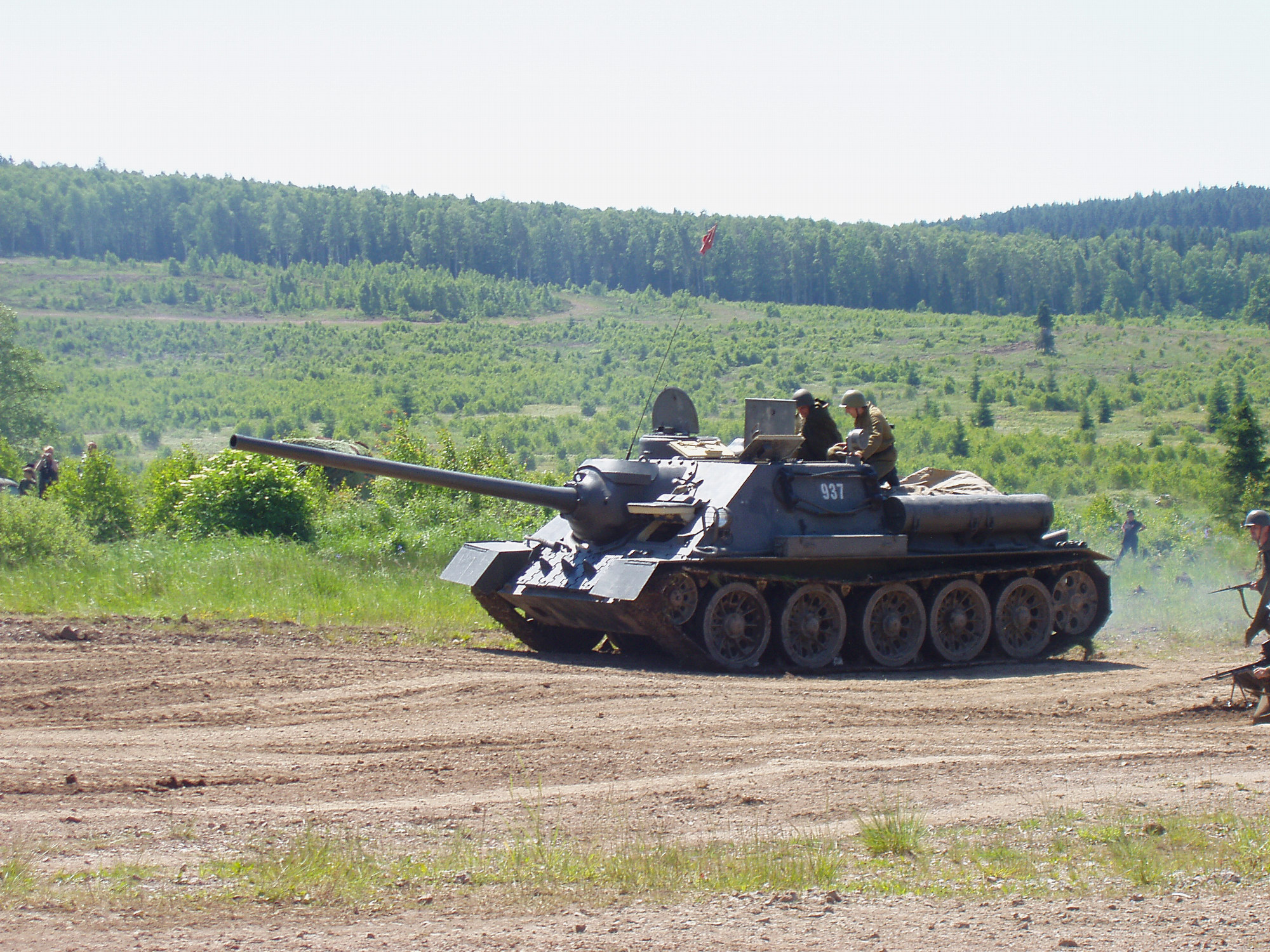
The army now had the T 34/85 as their standard battle tank, mainly
the SU-100, but still some M-10s and M-3s as tank destroyers in the Thematic infantry, and the Daimler
Dingo as the ubiquitous scout car. Most of the light tanks had been
retired and replaced with T 34s, but there were still a few heavier
British armoured cars in use. The Tagmata mechanised infantry were
mounted in M3
halftracks, while a still standardising range of trucks hauled the
Thematic infantry and artillery pieces, which were still a mishmash of
US, British
and Soviet equipment - of which the Katyushka was seen as a key piece - easy to use and devastating to men, material and morale. The ubiquitous Jeep was everywhere, impressing
even the mountain men of the Light infantry.
This stability came just in time, as the Cold War started to get a lot hotter in the 60's, and Byzantium realised it would have to upgrade its WW2 vintage equipment and probably also expand their military forces. It was time for a complete review, and this was started in late 1962 after the Cuban Missile Crisis sent tensions into the stratosphere. Like other front line small neutrals, Byzantium opted for the strategy of making themselves "not worth invading" by guaranteeing any opponent would lose too much to make it worthwhile. Core 10 year strategies were defined as:
- Mass conscription, mainly to train the population to be able to operate effectively as a reservist partisan force, but also to have a larger force-in-arms at any one time.
- Upgrade the armour, artillery and anti-armour components of the Tagmata to increase the damage to any invader in the early phases
- Improve the capability of the Thematic regiments by moving the replaced armour, Anti-tank and AFVs into them, likewise to improve their effectiveness to further ensure enemy casualties.
- Create a tactical airborne capability by using these new-fangled helicopters, and STOL aircraft.

The T-55 was introduced in the 1960's, and continually upgraded, still serves in Byzantium's Thematic forces. The reliable chassis has been used for multiple other vehicles as well.
So that is the backdrop, and as it turned out the 60's were not as bad as feared. Now, roll forward 15 years and its time to choose the next generation of equipment and define the TO&E for the closing stages of the Cold War where all this Alternate History is going to happen - in Part 3 over here
*Oddly enough, I may just have all these models already for the 2nd line forces ;-D
PS thanks to Don M for his thoughts from his similar outfit