Showing posts with label Cold Wars. Show all posts

Saturday, 27 November 2021

Modern Chinese Marines

Another Lockdown project, but yet to see the table....Modern Chinese Naval Infantry / Marines. When I saw the blue camouflage the Chinese were using I decided I didn't care if it was for show, I neeeeded an army painted like that as all my other Cold War/Modern armies are somewhere on the dirty green / muddy brown (or both) spectrum. 


When I saw Heroics & Ros did their amphibious landing craft/troop carrier the deal was sealed. All I had to do was work out how to render it. I wound up using medium and thin nib paint-pens (from China, natch) and it worked out quite nicely. (Based for FFOT, still deciding on whether to base for beach or more inland, I think the beach sand colour sets them off very well though.)


Another bonus - the colours and model size/shape in 6mm works for 40K Epic, I'm working on the Dreadnoughts, attack bikes and Terminators next...

Friday, 5 January 2018

Translating a 1938 Czechoslovakian Fast Division TO&E into the 1980's - Cavalry Division

Regulat readers of this blog may know that we have quite an active 6mm "Cold War Alt-History" contingent - ie "What If" WW2 hadn't happened? Especially in Eastern Europe.

Partly this is to allow us to create a non-Soviet  Eastern Europe and thus avoid the relative sameness of all the various Eastern European WarPac armies for our various Western nations to play against, partly it's to allow us to build What-If armies and fit in kit and organisations we like, within a context. The chap who kicked this off started with Poland, and other have take up the reins.

My WarPac Cold War armies is Czechoslovakia, and I wondered what Alt-Czechoslovakia may look like in this scenario. In the previous blog post I looked at what machinery they may heve built if the USSR hadn't taken them over (and stifled their own work) as pre (and during WW2) Czechoslovakia had first rate weapons design and manufacturing. The answer proved to be very interesting, they had a number of vehicles and guns in plans and prototype in the early 1950s, from light armoured "platforms" based on a successor to the Ps38/Hetzer/Marder II family, through amphibious AFVs to a first rate MBT, so one part of teh riddle was answered - tey won't use other people's kit, I have to "bodge" theirs.

This second article looks at how they may have organsed themselves in the 1980's. In the 1930's they were transitioning from a WW1 foot army to a Mechanised army. The majority of the army were still Infantry Divisions that were starting to motorise, but for the 1980's the most interesting structure was the Fast (aka Armoured) Division - 4 were planned, 2 were being built in 1938. So that's what I'm going to build.

Alt-Czechoslovakian army TO&E c 1988


 The TO&E for all Czech units is on the Niehorster website, below is the Fast Division TO&E for 1938


Fast Division TO&E from Niehorster

Looking at the top horizontal line, there are 4 main force components (ignoring the 2 HQ and Logistics functions on the far right) - left to right they are:
  • Cavalry Brigade, consisting of (again left to right, ignoring HQ):
- 2 Cavalry (Dragoon) regiments (battalions)
- 1 Bicycle Infantry battalion with 3 infantry companies, an MG Co (6 MMGs) and a Heavy Weapons Company with 3 x 81mm Mortars and 6 37mm AT guns
- Horse Artilley Battalion, this had 3 Batteries of 76.5mm guns


  • Armoured Brigade consisting of (again left to right):
- 2 Tank Battalions - at the time they had  LTV 35 and 38 Light tanks but they were supposed to be Medium tanks
- 2 Motorised Infantry Battalions - eventually the aim was to have 2 complete Motorised Regiments
- Artillery Battalion - this had 3 Batteries of 100mm Howitzers

  • Reconnaissance Battalion  (going down the line, ignoring HQ)
- Motorcycle infantry company
- Armoured Car company (12 armoured cars in 3 Troops)
- Light Tank Companty (16 tanks in 4 troops)


  • Divisional Artillery assets, again going down the line
- 3 x 20mm AA batteries (in FFOT scale)
- 3 x 37mm (other sources have 47mm) Anti Tank batteries

The first thing you notice comparing this division with an Infantry Division is the tanks and cavalry, obviously. The next thing is the lack of Divisional artillery (an Infantry Division has 3 more artillery batteries, including 2 heavy artillery batteries). I suppose the problem in 1938 was moving the big guns quickly enough. Other versions of this TO&E place the Tank brigade's Artillery Battalion at a Divisional level, which makes more sense as otherwise there are no Divisional artillery assets, but it would be still nice to have a complete medium artullery regiment of 3 battalions in the Division.

To be honest though there is surprisingly little change in Infantry formation structure between 1938 and 1988 even though equipment changes hugely. But direct translation falls apart with the Cavalry Brigade! Obviuosly therefore, the thing to start with is the Cavalry Brigade!

"What to do with cavalry" is a fascinating rabbit hole to go down, but I resolved to solve it by just trying to directly translate what they had in 1938 into 1980 terms, and see what I wound up with and  then "evolve" through the 80's based on gaming experience on the table.

Translating a 1938 Cavalry Brigade to 1980

To recap, in 1938 the Czechoslovakian Cavalry Brigade had 3 main components:

- 2 Cavalry (Dragoon) regiments (battalions)
- 1 Bicycle Infantry battalion with 3 infantry companies, an MG Co (6 MMGs) and a Heavy Weapons Company with 3 x 81mm Mortars and 6 37mm AT guns
- Horse Artilley Battalion, this had 3 Batteries of 76.5mm guns and 100m Howizers
First step was to translate the easier-to-translate stuff, namely the Bicycle Infantry and Horse Artillery.

Step one - Bicycle Infantry Battalion

In 1938 these were an attempt to mobilise infantry cheaply and without a need for a lot of maintenance overhead. I thought the simplest transition would have been to jeeps and then by 1980 to simple, small and  fast APCs. Going to motorcycles I rejected as no one in the 1980's has serious motorcycle forces, and besides they already had a motorcycle Recce unit in 1938!. So the structure became:

The 3 Companies of Infantry each have 4 Platoons of which:
- 3 platoons stay as Infantry, now in  APCs (older, well established APC required)
- 1 platoon is a "Special Weapons" platoon - over time this increasingly meant anti-tank. By the 1980's AT increasingly meant medium ATGW, so a platoon equiped with something like the Milan

The 1938 Heavy Weapons Company is well defined - Mortars, Machine Guns and Anti Tank weapons, so I directly tranlated them as follows:
- The 81m mortars are still around
- The 37mm AT was the biggest vaguely mobile infantry AT weapon and, being mobile infantry "Heavy" weapons I replaced it with a specialist Tank Destroyer vehicle with a weapon that could take out MBTs of the day. Initially gun based (a good opportunity to field a "3rd Gen" Hetzer ) they move to heavy ATGW over time.
- The MG platoon can go a number of ways, in many countries the MMG function was absorbed by moving to APCs (that had MMGs on them) and I assumed that would be the case here in the earlier post-war years, But it was noticeable that by the late 1970's,  armies started to sprout AA capability at a more local level again. The "standard" 1980 weapon would be some form of HMG/Autocannon AA, and maybe starting to transition to small Surface to Air missiles in the later 1980's.

Step Two - Horse Artlllery Battalion

Apparently there were 3 batteries per battalion, of 76.5mm field guns  In most WW2 armies these lighter guns went one of 2 ways - either replaced by similar sized but more portable mortars, got bigger, or evolved into Anti Tank support. I assumed that the Cavalry would deal with the AT role and that this force's job would be local artillery support so switched them to 81mm mortars, to match the infantry. I also cheated a bit in that I assumed over the years one Mortar battery would be dropped for an AA battery as tank-hunting aircraft became a more prevalent threat.

And finally - the Cavalry 

So, What To Do With Cavalry? In Czechoslovakia's case I thought there was a hint in that these cavalry were Dragoons, and had already been converting into mounted infantry, so they were Dragoons going "back to their roots" and there needed to be a strong "mounted infantry" component. What they needed was a good IFV, and the Czechs had an Lt38 based APC on their drawing boards in the late 1940's, so they were going to get (some derivative of) these..

But dammit, they were still cavalry, and had to have speed and elan and impact, and if there ever was a country with a proud tradition of making hard hitting light AFVs it was Czechoslovakia - and they had some designs on the drawing board in the 1950's that just had to see the light of day, albeit in 6mm. So that was it - a combination of mounted infantry in tough, fast, hard hitting APCs and tough, fast, hard hitting light tanks.

I can't find the number of squadrons in a cavalry regiment anywhere, but there were 3 squadrons in a tank Regiment so I assumed that held true in a Cavalry regiment. As the Brigade already has an infantry battalion, I weighted the Cavalty Battalions as 2 light tank squadrons and 1 mounted infantry squadron each. All 1938 squadron/company formations seem to be of "3+1" structure so I asumed 3 of the predominant type (light tanks or APCs) and the +1 was a support weapon type - which in 1980's Europe usually means AT capability.

Putting it together - the 1980's Czechoslovakian Cavalry Brigade

We use the Fistful ot Tows ruleset, it's scale is roughly 1 model = 1 infantry platoon, tank troop or artillery battery. In the 1980's therefore the above logic yields the following TO&E (numbers refer to models used. The structure below is how the above changes come out for the beginning of the 80's. Pplaying experience will quickly inform me as to what evolution over the 80's needs to look like :)


Czechoslovakian Cavalry Brigade, early 1980s

  • Brigade HQ
    • 1 Command IFV
  • Brigade Artillery Battallion
    • 2 81 mm Mortars + APC
    • 1 30mm AA  SPG
  • 2 Cavalry Regiments (battalions), each comprising
    • 2 Light Tank Squadrons, each of 3 Light Tanks, 1 ATGW (Milan Equivalent) Jeep/AFV
    • Mechanised Infantry Company - 3 IFVs + 1 AT Jeep/APC
    • 3 Infantry stands + 1 ATGW (Milan type) stand
  •  Motorised Infantry Battalion
    • Heavy Weapons Company
      • 1 81mm Mortar + APC
      • 1  Mass-HMG AA + APC (May convert to small AAM over time)
      • 2 "Heavy" ATGW APCs or Tank Destroyers
    • 3 Infantry Companies, each of 3 APC + 1 AT Jeep/APC/IFV
    • 3 Infantry stands + 1 ATGW stand  

I imagine that over time Jeeps will be replaced by more protected APCs.

As to what vehicles these are, that will be the next blog post, but in short I assume the following:

  • Any own-design or non-Soviet vehicle the Czechoslovakians had will exist in Alt-History - so OT-64, OT-65, DANA, Praga etc (ie models I have already should be usable....)
  • A number of improvements/evolutions they wanted to make to these can now occur - bigger guns on SKOTs and OT-65s etc 
  • Any vehicles they had on their own drawing boards (see previous blog post) in the 1950's will be used and evolved into a 1970's/80's successor. This includes:
    •  Replacements for the Lt38 family of fast, light AFVs (Pz38, Marder III, Hetzer) including an armoured APC they had in the works.
    • The Letak amphbious AFV, similar to the Russian PT-76 - I assume the OT-62 APC equivalent will be less influenced by the Soviet BTR-50 and have a more "Letak" look and thsi will also be reflected in their BMP-era 80's APC/IFV.
    • The TVP 51 MBT (and upgrades/a next gen successor)
  • Artillery, tank guns wtc of the requisitre calibres will be available
  • They are capable of buying or building comparable ATGW and AAMs to anything the West or Soviets have (or the French will sell it to them - did I mention I also have a French army....
As far as air support goes, in the 1930's Czechoslovakia had an aircraft industry building fighters/light ground attack and trainers but for bombers and fighter bombers they used Soviet and French equipment, In the 1970's/80's they still built their own trainer/light strike aircraft, so why change anything- still using Soviet & French heavier equipment seemed a perfectly reasonable path to continue (I mentioned I already have Cold War Czechs didn't I....)


Thursday, 27 July 2017

Cold War Czechoslovakia's own armour designs

Image result for TVP 51 Czech world of tanks

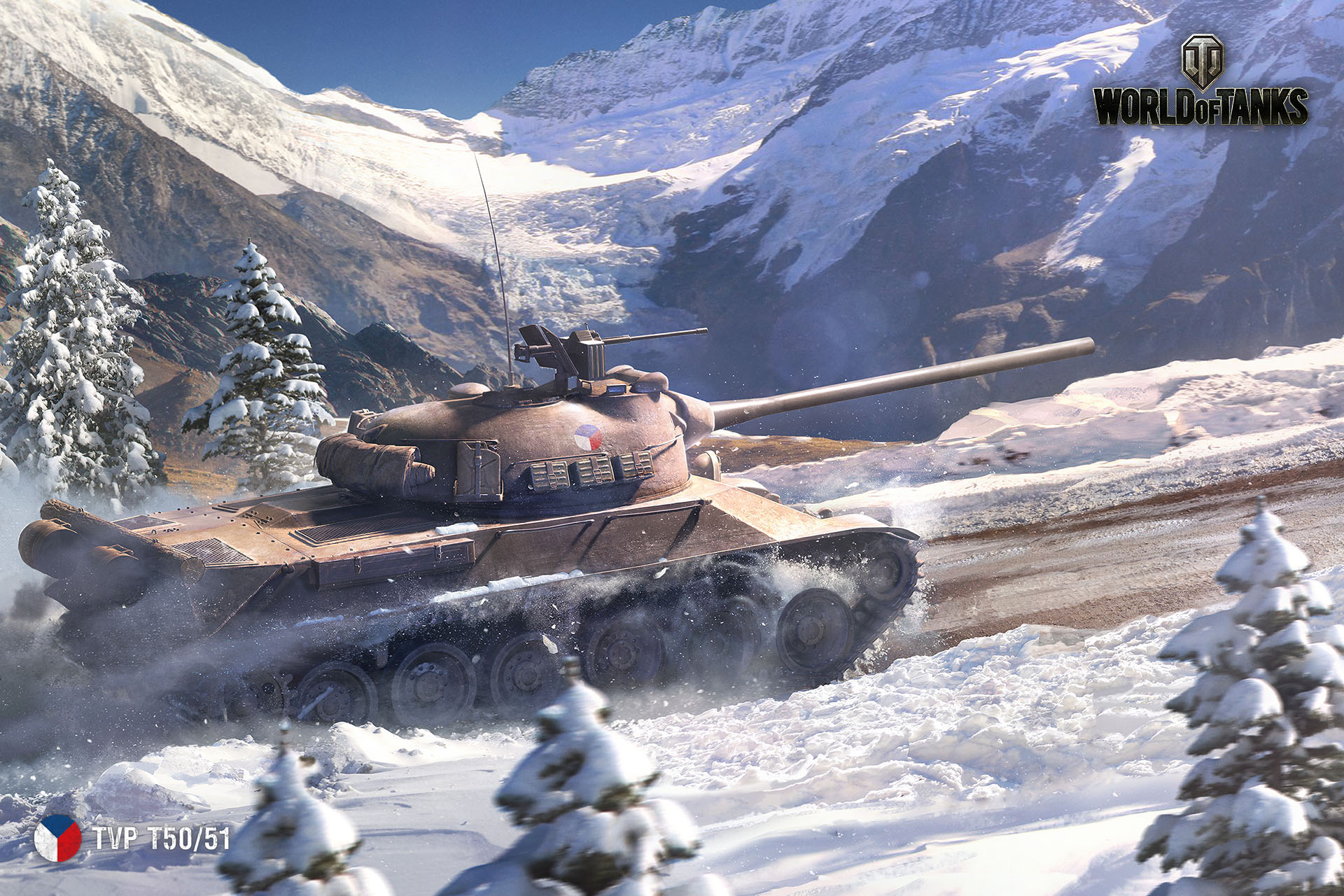
Rendering of the Czech TVP T51 design courtesy World of Tanks


Readers of this blog will know we quite enjoy playing with Imagi-Nations, from the 1700's to the Cold War.

One of my fellow gamers has conceived of an interesting  Alternative History scenario, where WW2 never happened. The idea is to build alternative 1980’s Eastern European armies based on what the real countries may have done in that scenario, and thus avoid the relative sameness of all the various Eastern European WarPac armies. 

He started with Poland, looked at who manufactured their equipment and then replaced it with 1980’s functional equivalents from the same countries. Now, one of my Cold War armies is Czechoslovakia, and I wondered what they may look like in this scenario - the answer has proven to be very interesting.

The first thing you realise with the Czechs is that in the 1930’s and 40's they built all their own equipment, they didn't buy it from others as the Poles did. They also were designing and building their own equipment until the mid 50's, when the Soviets effectively put a stop to it. And even then they almost automatically re-engineered all the post-war Russian equipment they were given, used a higher proportion of own designs than any other WarPac member  (their own wheeled APC  the OT-64  and various gun carriages plus co-operation with Hungary to build a scout car, the OT-65) besides their own trucks, guns and aircraft designs. 

So, it’s highly likely that with no WW2 and no WarPac, they would still have designed and built their own weapons systems. Thus with the Alt-History scenario Czechoslovakia it wasn’t so much about which other countries’ 1980’s equipment I would use, but more what would they have built and what may it have looked like (and then how to model and represent it).  

Usefully, it’s possible to get an idea of what was on their mind as their efforts were only finally stopped in the mid 1950’s. From the point of view of the noticeably different weapons systems (in 6mm scale armies) they had:

  • Planned how to update the Pz 38 series – the chassis had proven very reliable in WW2, the gun carriages and Hetzer tank destroyer had had a very good war (the Swiss carried on using a modified Hetzer into the 70’s). This new "Lehký podvozek" (Light tank) light tank was to use the Pz 38 running gear, the much better engines now available, and take lessons from angled armour in its design. The Skoda T-17 design was given a Czech high velocity 75mm gun. Given the success of the WW2 Hetzer & Marder,  Tank Destroyers and Gun Carriages were likely variants. An APC was also in prototype stage, and given the planned armour it would have been a proper IFV.
 Posted Image
T-17 Light Tank


  • Designed an amphibious tank, the U-9376 Leták, in 1954 - several years earlier than the not dissimilar Soviet PT-76 in shape and concept but with a high velocity 75mm gun, not the low power 76mm. There was already a previous floating tank project (VOŽ), and a suspension and floating system were already available. Given the Czechoslovakians used the OT-62 based on the PT-76 chassis it's not hard to imagine and an APC would have followed.  
Posted Image


Leták Amphibious tank

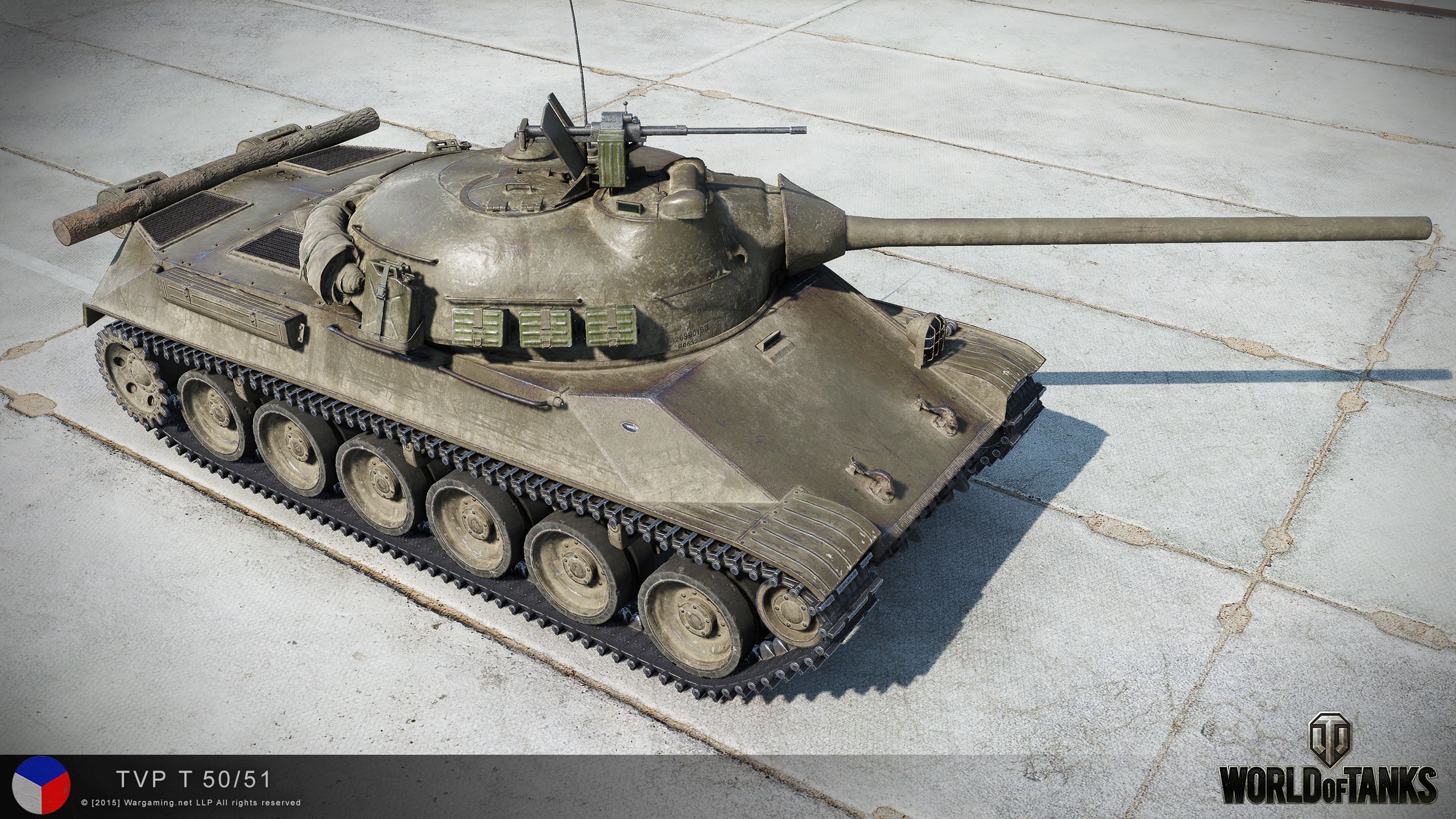
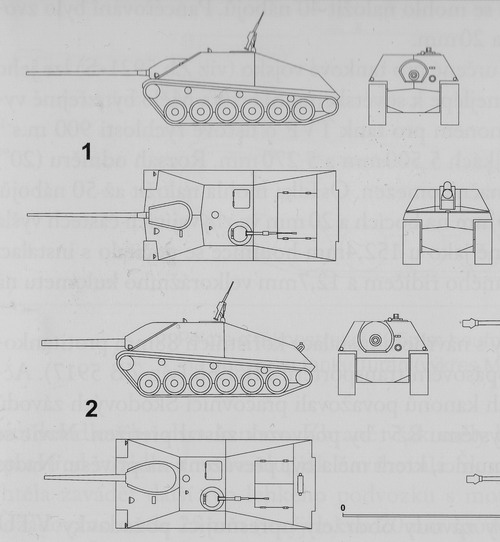
  • Studied the later war tanks, especially the T-34 running gear and angled armour, and were designing a new MBT based on a number of lessons.  There were a number of evolutions of the “Tank for general use” - Tank všeobecného použití (TVP) - project. Below is the final form, c 1950/51. There are also drawings of a Tank Destroyer based on this hull with a German 128mm gun.
Image result for czech tanks cold war TVP 50/51


Rendering of the Czech TVP T51 design by World of Tanks


Tank destroyer based on TVP 51 hull - initially designed with a c 100 - 105mm gun in mind, allegedly it could carry a Czech version of the 128mm German gun

The For the Record blog has a more detailed discussion of various projects

Thus, in an Alt-History world the Czechoslovakians would very probably have built an entire family of light armoured vehicles in the 1950’s, plus an amphibious tank (and given their conversion of the BTR-50 into the OT-62 they would very possibly have built an APC option too), and a post war MBT and (less possibly) a derived Tank Destroyer with their version of the German 128mm gun.

The Czechoslovakian designs seem in general lighter or average weight with more powerful engines, and guns at the heavier end of the scale. All these tanks apparently would have had autoloaded guns. 

There is no record of similar Czechoslovakian post war armoured car or wheeled APC designs, but if one assumes they would have built the OT-64 and OT-65/66 wheeled vehicles and their various artillery systems anyway, that gives a good basis. In addition they experimented with using heavier weapons on the OT-64 and OT-65 (up to 30mm cannons, ATGW missiles and 82mm RRLs, and the SKOT is easily big enough to take larger guns - so that certainly gives a good set of wheeled weapons systems to go with in an Alt-Czechoslovakian force.  

All of these would have been both for home use and export. So, for my Cold War Alt-History army, all (all....) that is required is to work out how these designs would have evolved from entering service in the 1950's until the next generation vehicles used in the 1980's, and then what non-Soviet army TO&E they may have used, and finally how to represent them on the table - but that is for the next blog post...

Wednesday, 18 November 2015

Cold War turns hot

The Backround

Recent posts have been about the "Cold War" Byzantine project - the genesis of this is that my club mate Iain has invented an Imagi-Nation force for Poland, set in the "Cold War" of the 80's. Except not only has he imagined a New Model Army for a New Poland. he has also posited an entire Alternative History based around WW2 not happening, but a seperate series of events moving off from a 1930's Europe.

Well this dovetailed into 20th Century Byzantium's imaginary history quite well - created as a Class C Mandate after WW1, parts of various defeated powers' territory - Turkey, Bulgaria and Austro-Hungary - were ceded to the new state - more details here, and the Byzantine Cold War forces are discussed in a series of posts ending with this one.

Anyway, the lack of a major war did not prevent all the various frictions endemic in post WW1 Europe causing a large number of local wars and incidents (cue lots of wargames opportunities....), but also shifting alliances and intrigues that make the history of the past decades rather, well, Byzantine.

The Encounter

Fast forward to the 80's, this means that, via various shifting alliance commitments, a Byzantine force was sent deep into MIttelEuropa to back up Our Peace Loving Allies against the Polish Expansionist Regime and its Lackeys. Trying to get away with as little contribution as possible Byzantium sent an Armoured Brigade, a Mechanised Brigade and a Light Infantry demi-brigade, a Position Artillery Battalion and a small air contingent, and this force has been operating on the Eastern flank of our Glorious Peace Loving Allies' advance into the disputed region of (the translation device fails here, there seem to be no vowels in the name), with the objective of seizing the market town of (Vxwzytu - translation fail) which sat at the head of a strategic valley..

Following Byzantine Doctrine from Leo's Tactica (revision No 1,453 published 1974) the 3rd (Thracia) Evzones (Light Infantry) demi brigade was sent ahead to take the town, while the 5th (Rhodope Theme) Mechanised brigade advanced on a broader front. (Byzantine  Demi Brigades are modelled on the French - a battalion of light troops with attached artillery and a light armour company of the famous Trapezitae). The first Evzone company is always designated as Recce, and is motorcycle and jeep borne, and their 3 platoons fanned out, one going north towards the town up the road, the others bouncing over fields to come in from each side (and see what may be out there). The ATGW platoon followed behind in its jeeps. Behind them the other 2 platoons in light trucks moved up, and behind that the Trapezitae Company of AML 90's trundled up the road while the Artillery Company set up its 2 Mortar and the AA Platoons and FAO in a hamlet about 1 km from the town.

The first inkling that something may go wrong with this plan was when autocannon fire raked the jeeps bundling up the road, setting a few on fire. The remaining infantry made a beeline for the hedgerows and hunkered down in the shrubbery for the rest of the game with their heads down. The jeeep ATGW platoon moved into the same bocage, and opened fire on enemy armoured cars visiible in the town. The enemy were clearly not expecting missiles and hadn't really hunkered down so a few armoured cars were brewed up in fairly short order..

Meanwhile the other Recce platoons had reached a wood on the left of the town, and a hill on the right respectively and both reported advancing enemy armoured cars plus troops moving up the road into town - an enemy Armoured Cavalry force  was trying to seize the same town, and had got there first!

The Demi Brigade has one company of armouerd cars as noted, but it looked like the enemy had 3, so the decision was made to dismount the infantry in cover and set up the ATGW platoons to prevent the enemy from sweeping either side of the town, while "our" armoured cars would see if they could rush the town with infantry following.

  20151116_210828

Byzantine Light Infantry debussing in woods to bring ATGW to bear

The Mortars started pumping smoke onto the approaches so this manouevre couldn't be spotted and hot at. However it transpired that the enemy infantry also got into town first so the plan of a rapid assault was scotched. Plan B was to blast the sh*t out of the town with artillery while formimg a line to prevent the enemy armoured cars from sweeping through either side, while seeking permission for Plan C - bring up some of the Mechanised Brigade as reinforcements.
  
Well, this was executed as flawlessly as possible in the fog of war by our Most Excellent Forces, and the enemy infantry spent most of the afternoon suppressed while the Byzantine ATGW's teams whittled away at enemy armoured cars, who vainly tried to hit teams of infantry spread across hedgerows and woods.

At <deleted by military censors> p.m. the T-55s of the Mechanised Infantry's tank battalion streamed up the road, swinging to both sides of the village to clear the enemy armoured cars and allow the Byzantines full freedom to smash the Poles in the village.

Except....the Recce jeeps reported more infantry and enemy tanks rolling up on their side of the village.... 

20151116_220218
Here comes trouble - Polish Vickers tanks roll up - their 120mm guns hugely outperform our T-55s guns and armour, This ensured the town stayed in Polish hands despite their Armoured cavalry unit taking sever losses

....and soon their tanks rolled around the village as their infantry entered it.. This seemed to cheer up the battered enemy in the town and a flurry of their ATGWs flew out, causing consternation among the conscripts in the lead Squadron of T-55s, and they promptly pushed oil into their tank exhausts creating a ton of smoke while they reversed tactically withdrew their tanks at full pelt.


 The end situation - for some reason the picture rotated and I can't un-rotate it :(   Anyway the white streaks show ATGW action at longer effective range than the tanks have, the blue lines are the Byzantine Retreat Strategic Withdrawal when the Vickers tanks (red arrows) moved up.Iinfantry in the hedges are very hard to get rid of, so the Polish armour was not that keen on pursuit -they had achieved their objectives anyway.


But the more worrying sign was seeing Polish Vickers tanks swinging into action, their 120mm guns effectively outranged the T-55's 100mm gun by a good 1000m, this was not a fight to be had for a village that the enemy clearly now occupied in strength anyway. Besides, Byzantine Doctrine is strong on the "He who runs away" bit, especially when its not really your war, and calling a massive barrage of smoke from the rocket batteries, the Byzantines armour retired into the gathering darkness. The enemy tanks didn't really want wnat to advance farther as they had already taken a few jits from Byzantine ATGW, so contented themself with reinforcing their position.

The Wargame Rules, OK

Fought with Fistful of Tows using Iain's initiative and C&C modifications

This was a very interesting and surprsingly entertaining game - essentially two quite strong recce forces going for the same objective. Both being totally made up, it was interesting to see how our respective TOE's fared. Infantry nunbers about the same, Poland had more armoured cars, Byzantium had fewer but had supporting mortars and more ATGWs. Both sides' armoured cars & missiles would KO the others if they hit, so it was a game of careful manouvering , playing cat and mouse and trying to snap at enemy assets while avoiding losses yourself before your heavier forces arrived. Byzantium got better dice C&C calling our off table Artillery in, so the Polish advantageous position in the town was partly neutralised by landing HE on their heads all game- until our FAO had a Blunder (double 1) and called it on himself, and a battery of 122m guns duly obliged..Parts of him and his Dingo are widely spread around a number of foreign fields. Also the Byzantine Light Infantry are crack troops so designated as "Good" which makes their shooting with ATGW better than the "Average" Poles's shooting (especially once they are suppressed!). However the Byzantine conscripts in their T-55s are "Fair" - quite fragile when taking incoming, and bailed as quickly as they could.

 
The Outcome

Byzantium had won the skirmish (it's official, its in our Military Archives, we won!), knocking out a lot of Polish armoured cars with relatively little loss to themselves, but ultimately the Poles had won the game by occupying the village. Their armour arriving gave them a superior position and forced us to retire.

An urgent request has gone back to Constantinople HQ to get some of the newer refurbed T-55s here PDQ, these older ones are not going to cut the mustard


The outrageously false propaganda account by the Poles of this battle is over here

Saturday, 31 October 2015

New Byzantium - the Cold War army

This is Part 5 of what has turned out to be a bit of a magnum opus (part 4 is over here)

When the idea of a Cold War Byzantine army occurred to me to fight Iain's Imagi-nation Poles, I thought it would be simply a case of choosing some kit and inventing a TO&E structure. It turned out I "needed" to think about the military strategy that the force was designed for, to get the "what" that the overall army structure of a Medieval system might make some sense in, and then to think about orginins - the post WW2 & early Cold War equipment that would still be in the army, just so the choices of the structures & equipment of the period we plan to fight (late 70's/80's) had a history and made a kind of sense in a context.

And then that bad man Don M and I started to explore all sorts of fascinating byways Byzantium could have evolved into, setting of even more ideas.

Anyway, enough of that, its all there in parts 1 through 4, and now on with the toys the army has in the 70's/80's (I'll ignore anything not really visible in 1/300 scale).. If you haven't tead them, the next section sums it up.

A Brief Summary of the last 4 posts' discussion on equipment


WW2 and Immediate Post War gear still in service

Post 2 covers this in detail. In short, German, Commonwealth & Soviet equipment was left when those forces pulled out (reluctantly, in the Soviet case) and it was all used, so the army of the 40's and early 50's was a polyglot collection of kit. Over the 50's they started to consolidate into a few types that (i) looked like they would stay useful longest, (ii) more could be bought cheaply and/or (iii) spares were readily available. As more modern equipment came in over the decades much was retired but the "best of" was passed from the elite and armoured brigades to the 1st line Infantry and then to the 2nd line reservist units.  T-34/85 tanks, SU-100 Tank Destroyers, M3 Halftracks, Daimler Dingios and Katyushkas, plus a variety of guns and reliable Soviet trucks still survive into the late 70's/early 80's force.


New Byzantium - first line Thematic motorised infantry battalion in the 1950's/60's - Jeeps with recoilless rifles as AT. Towed Mortars & AA. This is still the structure of 2nd line (reservist) Thematic units. TO&E follows Fistful of TOWS structure

In the 1950's and into the 60's, as with Yugoslavia & Finland, it was felt most expedient to buy Soviet equipment (Hungary was an example that was somewhat mind-focussing) - so over the 1950's various upgrades were made, but most re-armament was around continuing to rationalise equipment. The army folowed other border neutrals and gradually standardised around Soviet equipment, with a few useful old stagers like the M-3, Dingo & 25 pounder remaining..

Into the 1960's

Come the Cold war Hotting up, came a need to upgrade to equipment that wasn't really just WW2 vintage plus. New MBTs (T-55s) and other equipment was procured, an eye out at all times for good kit at a good price. Soviet supply was releced to an extent by other Warsaww Pact countries and neutrals. Towards the end of the 60's (after France left NATO) the Panhard AML-60 and 90 came in as new "heavy" armoured cars, replacing a variety of WW2 vintage armoured cars that had increasingly been kept running by duct tape and fervent prayer. .


The 70's

The 1973 October War had a big impact on military thinking, the Top Brass came to 3 main conclusions, in that an army with:
  • Better tanks in good defensive positions could KO a lot of enemy armour - fast
  • Missiles! Both AT and AA missiles brought the Arabs back into the war after they had lost their armour and any air superiority.  
  • You can stop a lot of nasty things with a big artillery barrage 
  • Conversely, enemy artillery barrages are nasty unless your troops are protected from them.
This drove 4 conclusions in the Future Army Review, and led to:

- an upgrade of the T-55 fleet as well as the serach for a new MBT
- a crash programme to equip AT elements with ATGW, and extend them to other parts of the force, ditto introduction of SAMs
- Increase in artillery elements (mainly mortars) at Brigade level as well as expansion of the rtilleery arm
- The need for an IFV for the mechanised infantry


The whole point of all this - the army of the late 1970's and 80's Cold Wars

MBT's 

Belisarius Man Battle Tank

The emergence of the T-72 in WARPAC nations' armies in the early 80's really rattled the Top Brass, as it was clear nothing they owned was going to stop this tank, upgrading the T-55 fleet further was pointless as they had reached Peak Gun with their French 105mm upgrade, and to an extent getting T-72's was pointless as it was going to be an older version of what they would probably face.  Interestingly, "neutral" (aka non NATO) France had developed an AMX-30 upgrade, the AMX-32, and was desperate for a first export customer at the same time Byzantum was desperate for a T-72 killer. The AMX 32 would eventually come with a 120mm gun that would actually stop a T-72 (soon, soon, said the French soothingly) and so, with a few mods and an agreement to allow a lot of local production, a modified AMX 32 was bought, with the French 105mm gun initially and promises of an upgunning (soon, soon). In Byzantine service this was called the Belisarius and started equipping the Armoured brigades in the early 80's. The last T-34's were withdrawn from the 1st line Thematic forces as freed up ex Armoured Division T-55's filled those slots. (Backstory - I bought a bunch of Heroics & Ros AMX-32s many years ago, so they were a shoo in for the MBT :-)   Much to my surprise, they are still on the H&R price list )

T-105 and T- 55 (Mod)

As noted, the T-55's were continually upgraded, those in the Tagmata are being upgraded to 105mm guns. As the Belisarius enters service T-55sare being moved to the Thematic 1st Line units, retiring  the last T-34s.into the reserve cadres

 T-105 tank battalion in Fistful of TOWS format , 3 companies of tanks and Cursores have Dingo w/ATGW. Camo is adapted from a 70's Czech pattern


T-34/85

T-34s are now mainly kept in the 2nd Line Reservist forces, having had various upgrades over the years. There is continual discussion about upgunning, but these machines are very old and refurbishment cost is not that different to replacing them with refurbished T-55s so that is the preferred approach, T-34 hulls are increasingly used to mount other weapons or as spares repositories. 

Tank Destroyers

SU-100

Still soldiering on as the Tank Destroyer in all Infantry brigades, over many refurbishments, including upgrades to 105mm L7 guns. As the ATGW vehicles and T-55s arrive in the 1st line units, the SU-100s are starting to be retired to the 2nd Line.

Missile using Tank Destroyers

Throughout the 70's/80's there was a crash programme of attaching ATGMs to existing APC and Scout vehicles. 


Armoured Cars

Dingo

Used in most Recce units, now increasingly being re-equipped with ATGW missiles. The WW2 era Dingo has been a workhorse for 40 years, as it is highly flexible and easy to run, and the State Arsenal has developed the capability to manufacture the car and it has had many upgrades over the year. It is often marked as "due to be phased out" but it has turned out to be a useful carrier for smaller AT and AA  missiles, as well as continuing to be a useful "armoured jeep" in the Light brigades and for all sorts of other purposes.

 VBL eat your heart out.....
 

 Panhard AML 90 & 60

AML-90 is used in the armoured companies of the Light Battalions, and the Recce companies of all mechanised infantry. AML 60 Mortar used in the light infantry.

 (A note - As with the Dingo above, I actually wanted to use the South African Marmon Herrington Mk IV which found its way into a lot of the Meditteranean & Middle Eastern armies after WW2 and soldiered on in quite a few of these armies until the 1990s, But no one makes any models of it in 6mm so I used the Panhard AMLs which is what the South Africans replaced it with.)

 Mowag Piranha 90

There is a need for a better armoured "heavy" armoured car than teh AML, and Experiments have also been made with mounting AML 90mm turrets on the Piranhas (see below), and these are progressing well....next step is to see if they can take a low velocity 105mm gun!
 

AFVs/APCs/Troop Transports

BMP-1s

It's a reflection of the era that the BMP-1, despite huge shortcomings, was the best IFV of its era. But it had huge shortcomings.Byzantium obtained some, but like Yugoslavia and Austria decide to develop their own.

OT-64 SKOT

The workhorse of the Tagmata for some years but now being shifted down 1st Line infantry units, also being equipped with AA or AT missiles as infantry AT APCs. Some are converted to carry mortars in the mechanised infantry units, replacing the BTR 152 mortar carriers. 

 Tagmatic Mechanised  Battalion, 3 companies in OT-64s and Dingo ATGW, Psiloi have a Dingo platoon as well as Jeep platoons. Artillery AA and Mortars are self propelled 


FUG  PZH 944

Main transport APC of the Light Infantry (apart from Jeeps) since the 70's, also increasingly being equipped with AA or AT missiles. Experience in the 70's showed that the trucks and jeeps used till then could compromise light infantry survival.  The OT-64 was felt to be too hard to transport by air and too cumbersome for the light infantry in difficult terrain and the FUG's were the smallest amphibious vehicles that could carry a full infantry squad available

Mowag Piranha

By the mid 80's it was becoming clear that the infantry needed a better armoured ride than the OT-64s and FUGs, and the Swiss Mowag Piranha family fitted the bill, as the 4x4, 6x6 and 8x8 versions could replace different vehicles.


BTR-152 APC & M-3 Halftracks

M-3s and BTR are still used for non front line tasks but are being pjhased out of 1st line units as OT-64s and FuGs are moved down the Line.

Jeeps & similar

Appear all over the army, but is the main vehicle of the Militia & Recce (Psiloi) units. Many of these are armed with HMGs and AT devices, where recoilless rifles are starting to be replaced by ATGWs.

Thematic 1st Line forces, 3 Companies of infantry in BTR-152s, ATGW in Jeeps, Psiloi company on LHS in Jeeps with HMG and ATGW, BTR 152 mortars and AA on RHS. OT-64s are in the process of replacing BTR 152s


Air Assets

The discussion with Don in the Comments below, and with Iain last night got me to thinking about Air assets. In Fistful of TOWS its unlikely we'll see much more than helos and the odd ground attack, so here are New Byzantium's.

Helicopters

- The WSK/Mi-2 is the main light helicopter, and is increasingly over the period is being armed with ATGW.
- The Mi-8 is the medium transport workhorse of air forces across the world, and so it is with New Byzantium.

- The Soviets won't sell Mi-24s, and the US won't give sell Cobras, never mind Apaches but Byzantium wants a tankhunting helicopter to replace older strike jets (and it's an excuse to have less tanks) and are watching the development of the South African Rooivalk with interest....

Aircraft

- L-29 Delfin/39 Albatros - Like many smaller nations, new Byzantum used the same plane for advanced training and ground attack work, and also like many countries, they kickstarted a jet aerospace industry by licence manufacture of the Czech aircraft.

Wednesday, 14 October 2015

Cold War Byzantium TO & E - Detail

Part 4 of a series exploring a hypothetical Byzantine state in the Cold War ere - Part 3 is here
Part 5 following is here

Byzantine Army Structure & Operation

The Byzantine Thematic system varied quite widely over 1,000 year as one would expect, and there was even variation at any one time, but New Byzantium will use the Thematic system at its height. Broadly this was (interpolating between a few sources) as follows for military structure:

- A Theme's (province/region) force consisted of 2 - 3 Turmai (brigades). Initially all were part time, over time a full time core emerged.
- The Turma consisted of c 2-7, some say 5, Moira (and other names - but basically battalions/regiments)
- The Moira consisted of c 5 Banda (Companies/Squadrons), again number of Bandon in a Moira vary.
- The Banda had 4 - 6 Allaghia (names vary but they are platoon equivalents) Note that the 6 subdivision was paired so in effect it was 3 (pairing is quite a thing in Greek and Roman armies, so may be a thing here too.
- The Allaghaia was split into 4 smaller units, various sources say 8, 10 or 16 men, these seamed to have been paired into 2 larger units each of 2 of these squad sized units.
The various "comprising of" numbers seem to be partly variation over time or circumstance, and partly as to whether a unit was infantry or cavalry (sources probably get confused too, and the meanings of unit terms changes etc. Take for example the shifting use of "squadron" or "troop" over the last few centuries). 

At the Turma (Brigade) level it seems that there could be infantry and cavalry Moira (Battalions), or infantry and cavalry of different functions in a force. That seems to be equivalent to a modern Brigade formed of (say) infantry and armour. The Byzantines did use artillery but not usually in field battles, that is a feature of modern era armies and needs to be factored in to any army structure.It's not clear if each Theme had its own artillery but it's certainly plausible.

Lower level organisation

Furthermore, Byzantine line units were split into different functions - both infantry and cavalry were split into Archers (toxitai) and Spearmen/Lancers. Cavalry units also had designated scouts (cursores) that were split off, infantry units had designated light infantry (psiloi), specialised infantry to break enemy armoured formations up (menavlatai) etc. In modern terms these were "support" troops to the line troops. The quoted ratios vary, but at all times about 25 - 40% of the force at a Company (Bandon) level were archers of some sort, for example  Various sources have this split at a squad and platoon level, some at a company level, and it may well be there was a matrix system where for eg archers could be grouped into one unit, as Grenadiers were in Horse & Musket times. But for example a cavalry Bandon had about 40% archers, these could operate in the line as back rankers shooting, or be thrown out as scouts, or flank supports - in fact it looks like they may have been allocated at a higher level for this work as the cursores - but these could also have been specialists, like a Recce company would be today. Looking at most armies' evolution it probably evolved from some being siphoned off as designated skirmishers, then becoming a recognised light component

Support troops and systems

Tactically, Byzantine forces used infantry as a solid core occupying space and giving shooting support, cavalry operated off this platform and were able to retire and reform behind it. Predominantly cavalry forces had infantry on mules so they could keep up, the Varangian guard rode horses and dismounted before the battle - in todays terms, armour operates closely with the infantry, and even mainly armoured forces had mechanised infantry components!


Byzantine Structures in a modern context

I have opted for using the following structures and splits to translate the forces into amodern idiom.
  • Somewhere between 25% and 40% of the units at any one level can have different support troops functions to the main unit.
  • I have held the "average" numbers of subunits in a unit as per the Byzantine standard, and designated the minimum unit to be the size of a modern squad, or an AFV
Thus the following theoretical structure emerges, translated into modern terms ("Support" as used below means a wider range tham archers or scouts, but with similar functions (Heavy Weapons, Scout/Recce, Artillery etc):

- A Theme is a divisional sized force comprises of 2 or more Brigades plus top level artillery
- A Brigade (Turma) is c 5 Battalions, of which 40% (2) are support Battalions
- A Battalion (Moira)  is c 5 Companies, of which 2 are support Companies
- A Company (Bandon)  is 3 - 4 Platoons, of which 1 is a support Platoon
- Each Platoon is split into 4 Infantry squads or AFVs, of which 1 is a Support squad.

At a Battalion level, this translated into the following generic structure::

New Byzantine generic Battalion 


Brigades will usually be made up of 5 battalions normally - 3/5 of the majority type, plus 2/5 of whatever support is required in that type of unit - so a standard Mechanised Infantry brigade is 3 Infantry Battalions, 1 Armour-breaking (I interpret this as anti-tank today) and 1 HQ/Support, comprising of scouts, allocated heavy artillery etc. Armoured Brigades are 3/5 armoured battalions, 1/5 supporting infantry, and 1/5 HQ/Support (heavy weapons etc)

(Note that as Ancient Byzantine organisations could vary from 2 to 7 Battalions in a Brigade, so might Cold War ones depending on task or level of completeness - Part 3 explained why post war and 2nd line units may well be incomplete).


A note on Support troops

There are 3 main functions as far as I can see:

Psiloi (infantry) and Cursores (cavalry) seemed to have similar roles - locate, harry, flank, skirmish with an enemy. They seem at the least to have existed at the Battalion level as indepenedent forces - these I use as the Recce functions, and they are fielded in considerable number as per Byzantine practice.

Toxitai (Archers ) and Hippo-Toxitai (Horse Archers) gave the low level units their firepower, so they are modelled as the 25% of support troops in the Platoon & Company level forces. However, they also existed as independent units to add firepower, these are modelled as the Artillery battalions in a brigade

Menauvletai (infantry) and Klibanophoroi (cavalry) had one role - to break up enemy armoured formations. They used hand to hand components, I have modelled them instead as the heavier Anti-Tank elements, held at Battalion level..

The Peltastoi

I formed  6 independent battalions "professional" light infantry (enough for the core of 2 brigades) to represent the enigmatic Peltasts - troops who were seemingly regular, and seemed to be involved as rapid response / rough terrain / assault  / fight in the line forces. In today's terms these seem to look a lot like crack rapid response light infantry, so that is how they are conceptualised here. The Greeks have a troop prototype that fits this well for the last 100 years or so, the famous Evzones.

Organisationally I envisage these units being structured as per the infantry at the lower levels, but closer to something like the Foreign Legion Demi Brigades (Battalion size units with support companies of Brigade level assets) in structure, if not the skill of the Legion - though I believe they will be formed of better than average troops. They thus are highly mobile, use a lot of lighter transports (4 x 4s), plus have a small but mobile heavy weapons (mortars, AT and HMG) and armour (heavy armoured car) component. This latter hards to the Trapezitai - light cavalry, but lancers so packed a punch - in today's terms the French and South Africn practice of fast, light armoured cars packing a real punch is similar.

Don & I also thought it may be fun to redefine some of the Trapezitai (trick riders) as motorcycle Recce troops.


First Line , Second Line & Akritoi (Reservist Forces)

A Theme also differentiated between First and Second line forces, and the Akritoi. First line forces were well trained and equipped, over time becoming full time and part of the greater Tagmata. 2nd line forces remained part time, tending to be less well equipped. I interpret that as First Line = Regular full time units of the standing army, the Second Line are reservists. The first brigade in every Theme is thus formed of a standing army, but 1-2 more Brigades can be formed of reservists etc, but are clearly not as well equipped. Post War, Byzantium's First Brigade was motorised, the Second Line had to walk, but by the 70's the First Line was mechanised and the 2nd Line were motorised to various degrees.

Akritoi seem to be a term for both all Border forces, and also part time Thematic soldiers who were a first line of response in times of invasion (probably both) while the Thematic army mobilised. Their role was to harry any enemy force, slow it down, split it up, ambush outliers etc. Don M and I have been having a good discussion about the Akritoi, and we have decided they could be represented today as a ready reserve of keen part timers, possibly mounted in "technicals" (aka 4x4 with fairly powerful weaponry bolted on the back), dispersed over the border towns in small units at squad and platoon level, maybe less formally structured. I have structured these as semi-independent companies that attach to the Thematic brigade to add to its Recce/Scout components.


A Thematic commander was also responsible for the Kleisourai, those manning the fortifications/ border passes/ strongpoints in the Theme, this was probably normally done with 2nd line forces.


The Tagmatic (full time) army consisted of  the guard units and full time cavalry (initially heavy, later heavy and light), and over time various specialist forces. Sizes of units vary, but given how quick the Byzantines were to organise mercenary units according to their systems, I can't see why Tagmatic organisation would have been much different to the rest of the army. As the Thematic forces developed full time elements the Tagmata grew to include them.

In Cold War Byzantium the Tagmata proper comprises of the Armoured Brigades, Light Infantry, Special forces and Army level artillery and Air assets, with the Thematic full time brigades closely co-ordinated and considered as psrt of the "greater Tagmata". 

Mercenaries

Speaking of the Foreign Legion, the Byzantine army always used a smattering of mercenaries, and after Manzikert increasingly relied on them. There were two main types of mercenaries - those that became regular units and part of the Tagmatic standing army, and irregular bands recruited ad-hoc.

I've used regular mercenaries as easy ways to access skills and numbers that otherwise may be hard to argue a small nation could possess  - the Latinikon, formed of mainly European tankies, les Biscotins (biscuit eaters), a Foreign Legion like infantry force. The Varangian Guard was reformed with White Russian exiles and post WW2 formed from those escaping communist regimes (and quite a few Russian deserters). The Tourkopoloi and Vardariots were formed after WW1 from ex-Turkish muslim and christian Balkan light horsemen originally, and keep their formative traditions to this day, though recruits now can come from many areas.

It's harder to model the role of the various irregular (mainly asiatic light horse) mercenaries, the closest  I can think of is bands of volunteers coming to fight for Byzantium in times of trouble, organised less formally and equipped in "Technicals" (a lowest cost bang for buck) operating as irregulars around the formal forces - as I imagined some of the Akritoi do, above.
Sunday, 11 October 2015

Cold War Byzantium TO&E - Adapting a Medieval army to the late 20th Century

Part 3 of a series of posts on building a Byzantium based Cold War Imagi-Nation, Part 2 is here

Some of the fun of pushing Byzantium into various future eras as an Imagi-Nation is imagining how its military structure would be transposed. To be sure, over 10 centuries the structure changed, so to an extent one "picks and chooses" one's structure, I have tended to take the structure  of the late Thematic structure blended with the iconic Tagmata of Komnenan times (11th - 13th centuries), albeit with a lot of certain amount of laxness.

The Medieval Byzantine army - an overview

The structure to be transferred has 3 main components:
Firstly, the Byzantine army was structured into regional provinces (Themes), each one provides an all-arms  military force (lights, line and horse), mainly part time. The central full time army (Tagmata) provides the elite heavy and light cavalry and the Guard units.

Secondly, the Thematic forces over time seemed to have consisted of the standing forces (by later Komnenan times these standing forces were also called Tagmata), and also partly of Akritoi - part time troops, who were activated as soon as there was any incursion while the Theme was mobilising.
Thirdly, the Tagmata in this period, as well as consisting of the native Guards and other heavy cavalry units, had a number of full time mercenary or discretenational units, recruited partly to make up numbers and partly for their specific skills. These were:
- Varangian Guard - Scandinavian, Russian and English heavy infantry, famous for their use of the Dane-Axe
- Latinikon - European mercenary heavy cavalry
- Skythikon and Turkopoloi - Asiatic and Turkish horse archers (actually its not clear if the Skythikon were part of the Tagmata per se, or just bands recruited on an ad hoc basis. I have assumed that at least one full time unit existed)
Two later Guard units emerged:
- Vardariots - Magyars settled in the Vardar valley, also light horse archers. They seemed to also have functioned as a sort of Gendarmerie/Military police as well as guards to the emperor on campaign
- Gianitzaroi - elite light infantry, probably archers, may be from the "Peltastoi" tradition.
A rather hard to pin down troop type, the Peltastoi also existed, these seemed to have been something between missile armed light infantry and the heavy infantry, and are used in assaults in difficult places so may be armoured infantry. Elsewhere they are called archers. I have assumed they are part of the standing forces, and are best modelled as fairly crack Light Infantry.

What has passed

This structure was shoehorned into a 1758 Imagi-Nation structure (here) and a post WW1 one (here) in different ways, and to an extent this Cold War structure is a continuation of the post WW1 structure. As with so many other armies the cavalry became the armoured forces, and other units evolved as well.

After a discussion with other Imagi-nationeers, in the 1758 army structure the Biscotins (Biscuit Eaters - aka Boukellarioi from Belisarius' time) was formed, a mercenary regiment of western style infantry much like the Latinikon mercenary Western cavalry, and has existed ever since. 

The Peltastoi of Byzantine times was transmuted into regular light infantry, taking on the characteristics of Evzone type Light infantry in the post WW1 structure as those seemed to fulfil similar roles.

A Note on Army size vs Country population size etc

I have assumed Byzantium is a typical mid size European nation, c 12m population. I structured it (very roughly) from the 6 Roman provinces  - Europa, Haemontus, Thrace, Rhodope, Dacia Mediterranea and Macedonia - that lie roughly where I thought New Byzantum would be situated (hence the 6 New Byzantine Themes in the army structure in the section below). I populated it (very roughly) from the Turkish, Bulgarian and Greek provinces the more Eastern and Southern bits of Thrace south of the Jiricek line. There is also the Theme of Trabazond on the Turkish coast, more a City surrounded by its mountains but based on part of the Turkish province of Trabzon.

Scaling Byzantium roughly on Yugoslavia, which had a c 20m population and c 140,000 troops, gives Byzantium an army of up to c 90,000. Scaling it on Austria, which had c 52,000 troops on a population of 8.5m gives Byzantium a relative force of c. 70,000. So a 70-90,000 man "full time" force seemed reasonable.

Yugoslavia had 30 standing Brigades when it restructured its Divisions in 1990, but in Yugoslavia about 2/3 of troops were conscripts. Byzantium's structure has less conscription, only the Thematic forces use conscription and structurally it's Brigades will be bigger than the Soviet model Yugoslavia used, so the 15 Brigades that Byzantium has is not at all unreasonable.

Ditto the Austrian comparison, Austria had a standing force of 3 armoured brigades manned with 15,000 full timers (and another 30,000 conscrpts in any year), whereas Byzantium is 15 brigades of full timers and conscripts, of which 1/3rd are full time and the Themes all have a full time cadre - so c 75,000 men by that calculation.

Yugoslavia also boasted 1m reserves (c 10% of the male population!) but that would be to man their national resistance force (didn't stop them quoting it as the total army size though). About 2% is the number normally quoted that one can call up without badly damaging an economy in the short term, so for Byzantium that is c 100,000 people as a direct reservist force, enough and more to man 2 more Thematic units for every one in the field . But in Yugoslavia (and Austria, Switzerland and Finland), many of these are kept semi-ready. Austria had 8 "ready reserve" mechanised brigades and 26 reserve infantry regiments for example. In Switzerland, each working age trained male does a weekend a year training, and keeps their equipment at home. Thus I felt it was quite possible to have a useful ready resrve to recruit for New Byzantium's Akritoi


Cold War Army Level TO&E

So after all that, going into the Cold War era the new TO&E structure is as follows:

Overall Structure

The military strategy of Byzantium is to create a force that makes taking and holding the country a proposition that is more trouble than its worth. This operates at 3 levels:
- A regular army that will cause damage in the conventional phase
- A countryside full of strongpoints and trained reservists to make occupying the country an expensive proposition
- Every male (and latterly increasingly female) citizen has had some miliray training, and is capable of fighting a guerilla war as they did in WW2.
The ancient Byzantine army is well structured for this approach, interestingly. It used a Brigade-like structure for the line forces, with elite full time, and various special forces held at Army level. I tried to size a similar structure roughly for a country of 10m population, albeit with a few mercenary units. In essence it has a full time Tagmatic army with 2 Armoured Brigades and 6 Light Infantry battalions plus special forces, plus army level artillery and air assets. Each of 6 Themes is responsible for a full time/conscript/ready resreve Motorised or Mechanised Brigade, plus an Armoured/Anti tank force - intilayy Company sized but increasingly battalion size as oledr atanks become available. In summary it comprises, by the late 1970's:

Tagmata
  • One Airborne Infantry battalion, One Special Forces battalions as part of the Tagmata
  • Two Armoured brigades, held at Army level as part of the Tagmata
  • Two Light rapid response brigades, held as part of the Tagmata as above
  • Army artillery assets
  • In addition to the Byzantine era, the Tagmatic army now has an Air component, with (oddly enough) quite a few foreign aircrew.
Thematic Units
  • Six First Line Thematic Mechanised/Motorised Brigades, one per Theme, made up of a full time cadre, troops in training, and a cadre of  readily available reservists from the ready reserve, the Akritoi.
  • Six Second Line Thematic Motorised Brigades, one per Theme, made up of a general muster of the younger ex-conscripts.
  • Trabazond is an exception - it is a small Theme and is slightly differently structured owing to both manpower and geography. It also always has a rotating garrison of the regular force. 
In more detail, this is how they are organised and what fits in where 

Tagmatic Troops

The Stratiotai and Latinikon (heavy armour) and Turkopoloi (light armour)  form the armoured core of two Armoured brigades, with the Varangians and Biscotins forming their infantry component.

The other Guards units form the special forces, the Vardariots are now an airmobile battalion and the Gianitzaroi are being  restructured as a Special Forces battalion.
The Tagmata also holds the Army level artillery and the Army Air Force squadrons 
  
Light Infantry Rapid Response Force

This is the Cold War evolution of the Peltasts. The Light Infantry battalions are nominally independent, operating as Demi-Brigades, (battalion size formations, with Brigade artillery and armour assets split between them) organised to be able to operate  with attached light armour and artillery.  These are deployed as rapid-response forces, but can combine to opearte as two full strength Light Brigades,
The Skythikon light armoured regiment is attached to them, to provide the light armour and Recce forces.
 Thematic Troops
Each Byzantine Theme was in theory to raise standing line infantry, light infantry, artillery, and a cavalry (armoured) component. I have assumed each Thematic unit is a modern all arms Brigade in full time establishment, with a divisional size force vailable with a full mobilisation of all reservists. The full time Akritoi light troops form the Reconnaisance and Scout formations in the Brigade. In the early post war years there was little armour (and not much mechanisation either) as teh Tagmata got all that, so the focus of armour was tank destroyers. Over time, as newer armour was brought into the Tagmata, the older tanks and APCs were refurbished and allocated to the Thematic Brigades. 

The Akritoi are part time troops, a ready reserve like a Territorial army, initially formed of ex WW2 veterans, then over time increasingly ex-Thematic regulars who had volunteered  to serve in a part time basis, and once conscription was introduced in the 1960's tended to be those who had finished service fairly recently. They are kept at roughly the same size as the standing forces.
In addition, each Theme has a list of all the ex-conscripts and in a time of emergency can call up a force of the same size as the First Line thematic forces, except they are less well equipped, being motorised rather than mechanised. A "first draft" is enough younger men to man a Brigade roughly the same size as the First line forces, a "second draft" can do the same again, but these are purely motorised and there is no armoured element.
 Fortifications
Each Theme also is responsible for hard point fortifications in it's lands, and typically mans these with conscripts in training or the Akritoi, who are called up about 2 weeks a year for refresher training.  

As well as this, a militia of roughly the same size as the  Akritoi is kept active, and typically has to train for a weekend each year. This is essentially the "2nd Line" brigade of each theme.
   
Tactical Level TO&E - evolution

As to the unit level structure, post War the line units were filled with volunters and whatever weapons were available from WW2 stuff left behind. In the early years the support functions were sparse - "Support" translated into "whatever could be purloined from dumped WW2 materiel".

Ditto in the early years, the  "Armament" issue was such that best the army managed was that each Brigade used (roughly) the same equipment - to make it easier to command, and reduce supply headaches. It was a day of great achievement when every line infantry company in the army could boast both a machine gun and mortar squad. It took quite a few more years for every line infantry company in the army to have the same mortar and machine gun in every squad, for example, and quite a few more years before all the front line Main Battle Tanks were of the same marque (never mind model number).

The detailed TO&E and equipment used in the period gamed - the 1970's to early 90's - is defined in Part 4 once I've finally made some  decisions. over here


(Thanks again to Don M for pushing my thinking along)
     

Saturday, 10 October 2015

Cold War Byzantium - the early Post War years

Part 2 of a series of posts where the aim is to build a force for the late 70's - early 90's to match my SLW colleagues' forces. (Part 1 is back here)

As noted in my 1st post its quite useful to think about the immediate post war evolution, to set the backstory (and the . This is it....

Byzantia went into World War 2, as did so many nations,  with what was essentially a late World War 1 army (see here). In the years before the outbreak of World War 2 they had hurriedly tried to convert their cavalry regiments to light tanks and armoured cars (to the disgust of many older cavalry officers). These proved capable of stopping the Italians, but the Wehrmacht quickly overran the country. At war's end, as well as German equipment left in a hasty retreat, both Soviet and Commonwealth units were in the country and both left equipment - partly as political capital, partly as it was cheaper to leave equipment there rather than take it back and scrap it. This, in a world of extreme austerity, would be the raw material that the post-war military force would be built from.

The army was reformed from the pre War roots, with no greater ambition than to get a force established quickly in very uncertain times - thus the pre-war Thematic system was kept, with the 6 European Themes again each providing - in theory - a regiment of 3 battalions, a cavalry (tank) battalion, and an artillery regiment. One battalion made up of wartime fighters was to be full time, one of volunteers in training, and one of reservists. In addition the 6 Light Infantry battalions were reformed from the partisans of the mountain regions. 

Trabazond, the Byzantine city-enclave on the Turkish coast, being far smaller and essentially a city surrounded by its mountains, has a Demi Brigade structure to defend its mountains or any shore based attack.


M3 Halftrack, used for many roles from WW2 on - including Tank Destroyer in the infantry regiments until the late 60's - was phased out of line usage in the 90's but still soldiers on in all sorts of minor roles. 

The lessons learned from WW2 - the importance of mobility, powerful armour and anti armour/ anti aircraft mobile artillery - were also implemented, and so trucks, AA guns and Tank Destroyers were parcelled put to the Thematic infantry regiments.

The central Tagmatic army, the traditional heavy force including the Guard units , was also restructured accordingly. The available battle tanks were allocated to the two reformed Tagmatic "heavy cavalry" regiments, while a ragbag collection of lighter tanks and armoured cars were allocated to the two reformed "Light" cavalry regiments - but these were now combined, along with the two line infantry battalions, into two Mechanised brigades. The two Light infantry Guard battalions were to be converted into those most cool WW2 forces, a paratroop battalion and a special forces battalion.


As much a morale boost for one's own troops, as to demoralise the enemy - Katyusha systems have been part of Byzantium's arsenal since 1945   

In the early years all these units were very understrength but by the end of the 50's they had started to reach planned strengths, and in addition had slowly consolidated their equipment from the huge miscellany of the 1940's to a smaller number of weapons systems, ones that they had believed were still viable,  with purchases on the second hand market. 

The army now had the T 34/85 as their standard battle tank, mainly the SU-100, but still some M-10s and M-3s as tank destroyers in the Thematic infantry, and the Daimler Dingo as the ubiquitous scout car. Most of the light tanks had been retired and replaced with T 34s, but there were still a few heavier British armoured cars in use. The Tagmata mechanised infantry were mounted in M3 halftracks, while a still standardising range of trucks hauled the Thematic infantry and artillery pieces, which were still a mishmash of US, British and Soviet equipment - of which the Katyushka was seen as a key piece - easy to use and devastating to men, material and morale. The ubiquitous Jeep was everywhere, impressing even the mountain men of the Light infantry. 

This stability came just in time, as the Cold War started to get a lot hotter in the 60's, and Byzantium realised it would have to upgrade its WW2 vintage equipment and probably also expand their military forces.  It was time for a complete review, and this was started in late 1962 after the Cuban Missile Crisis sent tensions into the stratosphere.    Like other front line small neutrals, Byzantium opted for the strategy of making themselves "not worth invading" by guaranteeing any opponent would lose too much to make it worthwhile. Core 10 year strategies were defined as:      

  • Mass conscription, mainly to train the population to be able to operate effectively as a reservist partisan force, but also to have a larger force-in-arms at any one time.
  • Upgrade the armour, artillery and anti-armour components of the Tagmata to increase the damage to any invader in the early phases
  • Improve the capability of the Thematic regiments by moving the replaced armour, Anti-tank and AFVs into them, likewise to improve their effectiveness to further ensure enemy casualties.
  • Create a tactical airborne capability by using these new-fangled helicopters, and STOL  aircraft.  
However, this would have to be done on the cheap, as the main expenditure would be on creating an air force with better equipment than late WW2 'planes, as the advances in air power had been radical and a military force with no modern air cover was a sitting duck. So it was back to the Used AFV Almanac, and trying to work out which pieces had the longest future potential. The priority was a new main battle tank. The T-55, Centurion and M-47 were contenders - the T-55 deal was the best bang for limited bucks and the Soviets threw in a whole load of refurbished BTR 152s and some scout cars into the deal to clinch it. Other equipment brought in over the 1960's included the French AML armoured car, plus various other T-55 based weapon platforms*


The T-55 was introduced in the 1960's, and continually upgraded, still serves in Byzantium's Thematic forces. The reliable chassis has been used for multiple other vehicles as well.

So that is the backdrop, and as it turned out the 60's were not as bad as feared. Now, roll forward 15 years and its time to choose the next generation of equipment and define the TO&E for the closing stages of the Cold War where all this Alternate History is going to happen - in Part 3 over here


*Oddly enough, I may just have all these models already for the 2nd line forces ;-D 

PS thanks to Don M for his thoughts from his similar outfit