Friday, 21 January 2011

Byzantia's 1920's/1930's military doctrine debates


Byzantia was created by the vicorious powers at Versailles in 1918, as a Mandate from lands of the defeated powers - Bulgaria and Turkey - and a bit of Greece to remind them of their recalcitrance in the hard years of WW1. Luckily for them their closest enemies were either wrecked (Bulgaria). busy wrecking themselves (Russia) or wrecking each other (Greece and Turkey)

In the late 1920's, the falout of WW1 is starting to settle down, which means these voracious neigbours are looking outwards again, so Byzantia is feeling the heat and knows it needs to sort out its defences. 

Byzantia's General Staff  is of course reading all the latest military theories and doctrines, while observing what people actually do as well:

Firstly, Air Power:

The French air force was the world's largest and most powerful when World War I ended in 1918. Although not a separate service, it nonetheless enjoyed a certain prestige for its excellent performance during the war. Things soon deteriorated, however. Demobilization hit the air arm particularly hard, partly because the army officers in charge gave preference in funding to ground forces and equipment. In addition, French politicians reflected the mood of the people, who were increasingly fearful of and pessimistic about a German resurgence. Defense policy, readily supported by the army, increasingly focused on a defensive stance in the east. The Maginot Line would stand as an impregnable and concrete trench when the Germans returned. Air theory, which in France stressed the offensive and revolutionary nature of strategic air attack (as it did in Britain, the United States, and Italy), was distinctly unwelcome in such a passive environment.

In both Britain and the United States, budget cuts took a severe toll on the air arms. In Britain, for example, the Royal Air Force (RAF) received on average a mere 15 percent of the defense budget, and in the United States, the Air Corps had an even smaller share. Similarly, the RAF found itself constantly under attack from the army and navy which sought to disestablish the RAF as a separate service and take back the airplanes they had lost in 1918. In the United States, of course, the Army firmly controlled its Air Corps and quashed ail talk of a separate service.

As you can imagine, the Generals really like this - the Air Marshall is somehat annoyed, and instead quotes Billy Mitchell, dreaming of fleets of bombers that can fly higher and faster han any fighter and project power from on high. So much so that he is arguing for Byzantia to set up shop and manufacture the flown then dropped U S "Barling Bomber" (above picture)

Secondly, the Land War:

The victorious armies were saddled with huge stockpiles of 1918-model equipment and ammunition and had to use up these stockpiles at peacetime rates before major new expenditures could be justified, so real change is very slow (and Byzantia can get its hands on this "modern" equipment easily and cheaply - as can their foes, sadly).

JFC Fuller is oft quoted, with his ideas to defeat the enemy by a "pistol shot to the brain" of enemy headquarters and communications, instead of by destroying the combat elements through systematic attrition. But to do that needs a fast twenty miles per hour tank (which cheap WW1 surpus is not) to exploit the rupture of defences caused by slower tanks, and men in trucks to keep up with them. But Fuller is ignoring the role of infantry in the mechanized team, argue ther opponents. Men in trucks is all very well, but that can't safely get them fighting in close coordination with armor.

France is choosing to construct a sophisticated version of the defenses that had apparently worked so well at Verdun, they will call it the Maginot Line.  The French doctrine seems to be viewing combined arms as a process by which all other weapons systems assist the infantry in its forward progress. Tanks are considered to be "a sort of armored infantry," subordinated to the infantry. The French cavalry are experimenting extensively with armored cars and motorcycles, and even half-tracks. These half-tracks sometimes formed combat teams with armored cars and towed artillery! There is much excitement over an embryo Light Armoured Division, with lots of Armoured Cars.


Very interesting for a small country that can afford some armoured cars and maybe new tanks - but large underground fortifications and fleets of bombers are a tougher ask, esecially in the anti-war environment of the 1920's/early 1930's

Some are even arguing that the German approach, concentrating all their resources on a relatively narrow front for breakthrough. This concentration of forces requires the careful integration of all weapons and arms at battalion level or below to overcome the enemy's defenses. The infiltration tactics of 1917-18 reflected this viewpoint and were retained after the armistice,the 1921 German Regulation on Command and Combat of the Combined Arms included not only the infantry assault battalion and the carefully planned artillery and preparations of 1918, but also close air support, gas warfare, and tanks in an Infantry-support role. But the Germans lost the war, so what could they know?

Some of Byzantia's officers (quite a few ex White Russians and Greeks) fought in the Russian Civil War. Because of the vast distances and understrength armies involved In the Civil War, penetration and encirclement were no longer difficult, and fluid maneuver was the rule. Cavalry rules! shout the horsey types. However, Russia was far more open than the hilly Balkans, so others are arguing for using the terrain as much as possible, and training specialist troops to use it well and "be like Ghosts".

There is also a trend in all armies to move from the "square" 4 platoon and 4 company structure to the "Triangular" 3-platoon - 3 company structure. Take the Americans for example, Pershing is banging on about moving the machine gun and other specialized heavy weapons into the infantry rifle organization at every level. To avoid an excessive span of control, each commander has a headquarters, three subordinate rifle units, plus a weapons unit--three rifle platoons and a heavy weapon platoon in each company, with three such companies plus a heavy weapons company in each battalion.

And then there is the question of how to pop enemy armour - Heavy Machine guns can nail armoured cars and light tanks, but you need something at a lower level, as combat experience showed. Last but not least is what to do with the Chauchat - Byzantia was equipped with them by the French and they arre still the primary squad Automatic Rifle, and it works far better in the hills of the Balkans thean the gritty trenches of France - but maybe get a weapon with more firepower - or just have more Chauchat teams?

So, a ferment of change.....

Hat tips here and here

Monday, 17 January 2011

Odessa Files Part III - Baptism at Bleidska


We played the "Mud & Blood" scenario "Baptism at Bleid" but as a Russian Civil War Scenario. A Bolshevik force has infiltrated Greek lines overnight, and in the early morning mist, Comrade Rommelski and 4 men crept around a farmhouse overlooking the hamlet of Bleidska (Position X), and found a Greek platoon bivouacked in the hamlet - half the platoon was getting tea and blini from the farmers wife (Position Y), the other half were still packing their blankets, making breakfast and filling their water canteens from a well in the cherry orchard and fields behind the farm buildings (Position W). The Bolsheviks must have a foothold in  Bleidska so the main force following up behind can force the gap.

Rommelsi ran back to his company following some way behind him (Position Z), and urged them forward as quickly as possible, taking care to put one section in the farmhouse and one in a nearby barn to give covering fire. then, with Rommelski in charge , the rest charged down the meadow into the hamlet as quickly and quietly as they could (A Level IV Big man can really make a force move).


Greeks bivouacked at the Farmhouse in Bleidska - Comrade Rommelski is in the house at the top of the picture spying out the lay of the land

Lieutenat Kleftikon and his two NCOs were drinking tea and chatting up the farmer's daughter when the shapes emerged out the mist, charging down the meadow towards a gate entering onto the road (we moved it from where it is by Y on the map to the T junction). Kleftikon ordered one squad into the house to shoot at the Bolsheviks, while he ran with his other squad to the hedge so they could shoot at the Bolsheviks running down the meadow . However, there were too many of them, too close, so in the time honoured tradition of the Evzones he pulled out his sabre and with Corporal Stifados and his squad fixing bayonets, they charged the Bolsheviks (Heroic man card arrived in the nick of time), hoping to catch them at the gate, a narrow bottleneck, and drive them back.  Unfortunately it was not to be, and thee Bolsheviks rapidly overran Stifados's squad, wiping it - and Lieutenant Kleftikon - out. (Anybody within 9" can join in the scrap, even at a bottleneck)


Sneaky Bolsheviks sneaking round the farmhouses, ready to attack the unprepared Greeks (top of picture)


However, all the noise had alerted another squad camping in a nearby field, and they came running (arriving on table at point V) and occupied the farmhouse on the extreme left of the village where they started shooting at the bolshy Bolshies.. Lieutenant Kleftikon's heroic charge had also given the men in the orchard behind the farmhouse time to try and pull themselves together. This was ultimately to be decisive, but for now the Bolsheviks came pouring through the gate in numbers, one section grabbed a large log to batter the farmhouse door down, faltered after some desperate shooting from the Greeks in the houses, but with Rommelski urging them onwards for the Motherland (and threatening to shoot any dog who didn't go forward), they bashed down the door  before falling back in disorder as a hail of shots came out the house. However, they had done their job, and more Russian charged into the house and threw the Greeks out (the farmer and his family having long since fled).


Bolsheviks charge down the meadow to the field gate, hoping to overwhelm the unprepared Greeks before reinforcements can arrive. At the left top of the picture by the trees is Sergeant Stifados' squad, about to be led on a suicide charge by Lieutenant Kleftikon. Gee thanks....


However, the Greek troops in the fields behind the farmhouse had gathered their wits and promply charged the Russians in the farmhouse, and a fierce struggle ensued  which the Greeks eventually won (when in doubt, throw sixes) ejecting the Russians who retired back up the meadow and regrouped behind a stone wall, Rommelski furiouly urging them to try again. They were preparing for a second attack against the depleted Greeks, but at that moment the rest of the second Greek platoon arrived on the table and the Bolsheviks retired, leaving the somewhat shaken Greeks still in control of Bleidska.

Summary - a very exciting game, so exciting that we forgot to take any pictures of the ebb and flow fighting around the farmhouse - the "Mud & Blood" card system really worked well here, not only sowing uncertainty but also some uncannily timely cards - a Greek "Heroic Leader" card for the Lieutenant's charge, a "Friction" card causing delay among the men in the orchard when they saw teh Russian charge, a Russian "Up and at 'em" card just when the men battering down the door needed it most, and so on. It worked less well getting the Bolshevik force from far corner to the attack as the workflow is tedious going through cards waiting to activate each sub-unit, so we may institute "march moves" in future.

Saturday, 15 January 2011

A very civil society


The post waggon brought the long awaited civilian contingent this week - the Old Glory "Fat Island Governor" set and Eureka's String Quartet with Fred n' Voltaire, and "Ooh ain't you awful".  Enough for some high and low society vignettes and characters for both the Corps du Vin and New Byzantium (the above picture from P.Joux's collection of the Marquis du Pinotage spying out the lie of the land suggests itself with the figures now arrived).

Wish I could find more in the Turquerie mode though. Sadly, the Basilea Phannae has banned the practice of Harem-keeping by the Byzantine nobility (she knows of what she speaks*), so this is out.

*Justinian had Theodora, and the tradition is mantained.....

Monday, 10 January 2011

Odessa Files Part II - The Liman Race

Some photos from tonight's game - we played the "Mud & Blood" rules using the "Race to the Sea" scenario to teach ourselves the rules, except it was a "Liman Race" between Greeks and Bolsheviks around Odessa, 1919 during the Russian Civil War. (Liman are huge lagoons around Odessa - see map here, we played our action just East of Cerbka where the Greek and White Russian sectors intersected). The terrain map is shown below:


The objective is to seize the river bridge in the village on the right - the Greeks to stop the Bolsheviks crossing, the Reds to prevent the Greeks blowing it up.. The battle was fought between a Bolshevik force of about 1 platoon, complete with Putilov armoured car, and a Greek force of a similar size supported by a squad of White Russian Cossack cavalry. Here are some pictures- the Bolsheviks marching along from point B above:


And here are the Greeks marching along (below). These are the crack 5/42nd Evzones Regiment (don't know if they flew the flag in action in 1919, but all photos and pictures of Evzones have them heroically flying the flag, so by St Spiros mine do!).


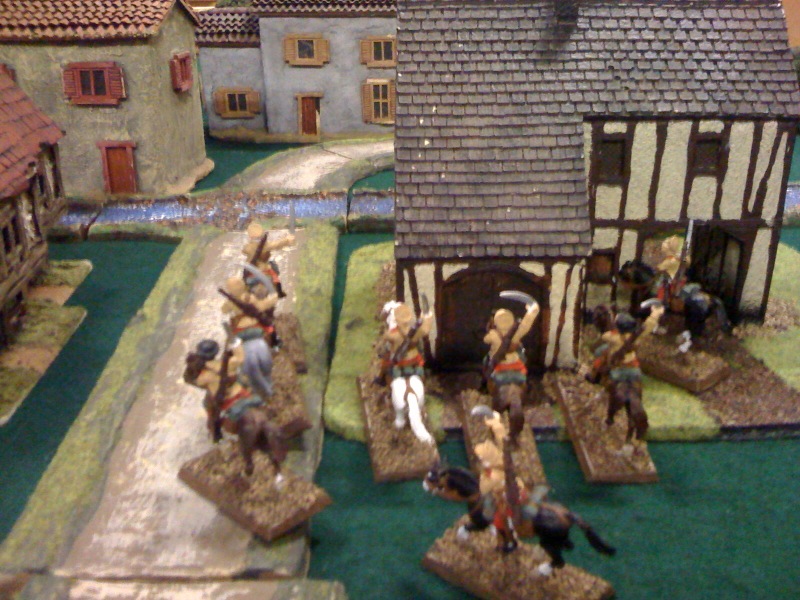
The game was an honourable draw, the Whites/Greeks getting to the village first with the White Russian Cossack cavalry (below) and Greek cavalry but being pinned in the houses by the Putilov armoured car's twin machine guns (it broke down on the Russian side of the village just around that corner, thank heavens - the Greeks had nothing to hurt it with and it would have wreaked havoc) but the Bolshevik infantry could not approach the village as the Greeks were in the houses on their side and along the river bank covering the approach.


Rules were fine, but a bit slow as (i) we were learning them and (ii) they could be a bit better laid out, and the quick reference sheet has a lot of tables missing. We liked the unpredictability and things like the machine guns jamming, armoured car breaking down etc. Excuse the photos blurring, pictures were taken with mobile 'phone.

Thursday, 6 January 2011

Christmas in New Byzantium.....

Today is Christmas in the Orthodox world, owing to the use of the Julian Calendar. There may be a present - a messenger has been sighted galloping down the Via Byzantion with news of a battle at Apl Trnova....

Tuesday, 4 January 2011

A short, sharp bit of practice


"Don" Dharko's bandit bad boys, 400 in all, came down off the hills at dawn to loot the granary and depot at Apl Trnova, in the northeast (see here for the beginning of the tale). All that was facing them were the 50 men of the Granary garrison and the local vardariots (gendarmes - think Huszar type troops above), again about 50, but they are mounted.

(This was a basic skirmish to start getting into the Sharp Practice rules - figures not fully painted yet and terrain was rudimentary, so no gaming porn pix for y'all)).

Anyway, the bandits came off the hills more slowly than they would have liked, and that allowed the garrison in the granary and the Vardariots in the town to loose off a few telling rounds. There is a long open meadow and a stream between the hills, and the granary and town, delaying them further.

The Vardariots were mounted, and charged the bandits at one point, causing quite a lot of damage on some stragglers before retiring before they were swamped.  The bandits suffered quite a few casualties in approaching the granary but finally got in, and the remaining garrison fought their way out a side door.

The action took a few hours in scale terms, but now its the bandits who have the problem - they have the granary, but the Byzantines are behind barricades in  the town and are sniping at them whenever they move, and hauling the loot over the long meadow is quite hazardous.

What to do therefore? Attack the town and secure the loot, or make off with the loot they can before nightfall and probable Byzantine reinforcement?

Conclusion - short battle, 4:1 odds but 2 "Small" big men in the New Byzantine side allowed them quite a lot of manouvre vs the unfortunate "medium" big man Don Dharko who definitely needs to up his initiative (the Sharp Practice cards were against him...). Also, being in hard cover was very useful.

Sunday, 2 January 2011

On the fashion for Turquerie....


The Basilea Phannae in Turquerie dress  (that is, she wears the trousers...)

One of the tricker tightropes that New Byzantium has to navigate is that of Fashion. The Court is determined to be as attractive to "Western" powers (including Russia) as possible, while also not annoying the Porte too much (the Trebezondine emigres' wish to name the border forts in the Georgian fashion nothwithstanding).


New Byzantium has thus enthusiastically become a leading spot for dedicated followers of Turquerie, the fashion sensation of the age - blending European, Balkan and Turkish fashions. So much so, in fact, that there has been an emergence of major fashion houses in Byzantion, with designers such as Dyor and Xanel exporting their fashions even to London and Paris.

Nonetheless, the regular military and court has been ordered to wear Western dress as far as possible (clearly the Western superiority over Turkish arms is driven by the cut of one's cloth) - with the exception, of couse, of the Turkish national units in the service, like the Gianizaroi - zo suave, as zey say.....

(Although it must be noted with interest that the West is enthusiastically adopting the dress of the Balkan huszars, the mainstay of the New Byzantine light cavalry, and Marshal de Saxe dressed his lancers in a way very reminiscent of the Sipahoi lancer cavalry).

Somewhat surprisingly, we find that 28mm figurine manufacturers do not quite share the enthusiasm for Turquerie, thus the need for Green Stuff in New Byzantion modelling.