Showing posts with label Odessa Files. Show all posts

Sunday, 9 June 2013

Breaking Out is hard to do

The Red army has surrounded a small pocket of Franco-Greek forces near Kherson, and the Greeks are attempting to break out. A probe attack by a company platoon of the 5/42 Evzones was launched early in the morning, after a pre-arranged barrage by Allied artillery in Kherson. The Greeks beliebved that there was a weak point on the North road where two large woods interected the lines of Red dugouts and spanish rider barked wire lines. They believed they could get into the woods and break out that way.


Red Lines, showing the 2 woods the Greeks decided to assault, the plan was to focus on the closer one, break in and then break out (red arrows)

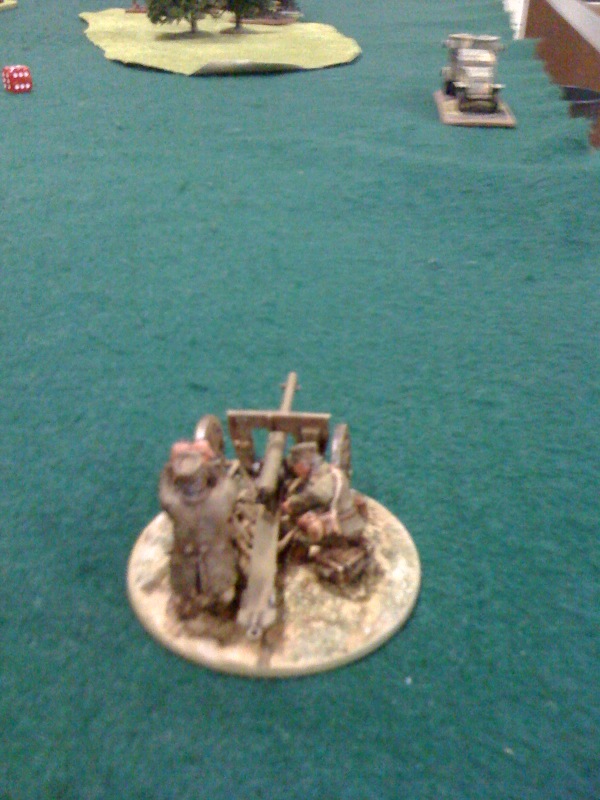
As dawn approached, the Greeks filtered quietly through the trees towards the objectives. The Evzones were reinforced by 2 French FT-17 tanks and also brought up one of their Mountain Guns for close support. They decied to assault the rightmost wood en masse, while sending a diversionary force against the other of the 2 tanks, hoping the Reds would think there was a mass of infantry behind them, and mis-allocate any reserves

The barrage started, the tanks gunned their engines, and the infantry started rushing forward, acros teh open ground, one platoon behind the next. The Reds were shaken from the barrage and initially there was very little shooting from their lines, but the Red forward commander guessed correctly what was happening and rushed a squad to a large house just ahead of their lines so they could enfilade the Greeks as they broke out the trees. The Greeks had to divert one of their own squads from the assault to cover this off.


The Greek infantry attack in 2 waves, concentrating on the rightmost flank.

On the other flank the tanks advanced slowly. Initially they were pestered by snipers in a house in front of the Red lines but the 2 tanks raked it with MG fire and the mountain gun put a few rounds in, and it what was left of the house was then all quiet.The tanks trundled on at their magnificent 4 mph maximum speed.

Greeks forces were now starting to get close to the Red lines, but now the Reds had thrown off their shock and started shoting back, taking casualties off the Greeks. At this point it also became clear that a large barn and sandbag wall to the right of the Greek position was becoming a major problem. A squad of Greek Evzones moved up to the spanish riders barbed wire and started shooting at these troops, trying to get them to keep their heads down. The Greeks had Chauchat LMGs whrereas the Reds did not, and this helped them keep a suppressing fire. The Greek captain then signalled the mountain guns to place a salvo on the house, which they did, and that stunned the Reds shooting from it.


Red troops man the sandbag walls by the barn, shortly before the Greeks dropped a mountain-gun salvo onto it

A Red forward party of snipers, egged on by a Komissar, then moved into some shellholes in front of Red lines to enfilde the Greeks, and killed the Greek Captain!. The Greek lines wavered, but then a squad of Evzones charged the snipers, and took them out with cold steel They in turn were then pinned by fire from the Russian lines, but they had stopped the enfilading fire and the first Greek squads gained the woods.

On the other flank, the FT-17s were drawing closer to Red lines, and a Red field gun that had been brought up opened up on them, missing them narrowly. The close support Greek mountain gun shifted fire to silence the Red gun, but it was well hidden in some woods and remained a major threat. The tanks raked the position, trying to suppress the gun, but it would only be a matter of time before it started to knock the tanks out. The Reds also at this point decided to commit their reserves to stop the infantry attack, confident that the tank breakthrough was less likely, but the ruse had worked quite well, giving teh Greeks valuable time - the Reds would be attacking a wood that the Greeks were now moving into.


Red field gun starts to shoot at French tanks over open sights

At this point a noise grew louder, and  overhead a Geek Navy DH.4 was seen. The Greek AO had called it to take out a redoubt on the Greek infantry's left hand flank, but the Greeks in the shellholes were keeping that position's heads down. The semaphores waved desperately from the ground. The DH.4's observer picked up the change, banked and made towards the Russian gun firing at the tanks. A Red MG started to fire desperately into the sky but it was to no avail, the DH.4 made a strafing pass, banked, and then came back, and dropped its load on the position. There was silence from the gun after that.


Greek Naval DH.4 makes low pass over Red positions before bombing the Gun and trenches

And then, just as the Greeks were starting to enter the woods, we ran out of time. It was pack up time. The result was in the balance. Could the Greeks have reinforced the wood in time? Would the Russian reinforcements get there in force first? In counting up the casualties it transpired that the Greek initial barrage had been fairly effective, so Red casualties had also been high and forces were evenly matched still, and the Greeks were more concentrated, but we judged that the loss of the Greek Captain meant the Greeks probably wouldn't have been quite co-ordinated enough to hold the wood and reinforce it fast enough against the oncoming Red wave. The Reds breathed a huge sigh of relief as the Greeks withdrew.

Battle using Bolt Action, the WW2 rules even have the FT-17 tank in it! Sadly we ran out of time just before the real decisive action. I'm very proud of my DH.4, I still need to put the blue centre spots on the Greek roundels but it acquitted itself very well in its first ever sortie. (Its a 1/48 scale Roden kit, and its a bugger to assemble the wings!!)

More Red propaganda and puictures over here from Komissar Janos

Friday, 7 June 2013

Action at Kherson

We resume our Odessa Files mini-campaign with Bolt Action rules used for WW1. In the scenario, a platoon of the Greek 5/42 Evzones is holding a hamlet on the Kherson approach road, which a Red reinforced company with armoured cars and heavy weapons is hoping to overrun in a short, sharp attack. There are French of variable quality in reserve, who may or may not come to the Greeks' aid (depending on dice).


The sleepy hamlet, Greek Evzones are billeted in the houses on the far side of the left-right road in the centre

The Reds decided to attack in two platoon columns with supporrting machine guns along the 2 roads (running bottom right to top left, picture above)) with an armoured car leading each column, while a third platoon and field guns were to be in reserve, to be thrown in where a breakthrough was made.


Red column moves rapidly along the road, led by an armoured car. Field guns start to move into position

Unfortunately for the Bolsheviks, the Greek vedettes were alert and saw one of the columns very early, and promptly loosed off mortar rounds at pre-prepared targets, destroying a Red squad in the right-hand column at the crossroads on the Red table entrance. The Greeks also rapidly sited their machine gun and loosed off a burst, catching another squad in the Red left hand column that had moved away from the shelter of the armoured car.

The Bolsheviks, realising they were rumbled, then rushed forward as fast at they could to the give the Greeks the minimum opportunity to shoot them. The armored cars rumbled forward, trying to suppress Greek shooting positions. 

It soon became clear to the Reds that the Greek troops in the big house in the centre of the table were a major problem, so they tried to rush it with 3 squads from their left column and reserves, while their armoured cars, a machine gun and more of the reserve line moved up and raked the house. Greek casualties were high, but the Greek platoon's commander kept spirits up (at sabre point at times) and they just held out, but it was desperate times and they were still in dire straits.


Red troops, egged on by their Komissar, charge the Greek house (far distance)

 On the Red right, the column got over the shock of the mortar fire and moved forward as fast as it could, and mortar fire effectiveness reduced. They also got their gun unlimbered and began to shell the Greeks sheltering in and around a small house on this far flank. The Red armoured car pushed forward and got onto the flank of the Greek position, its machine gun enfilading them and causing them to keep their heads down and suppressed their fire while the Red artillery opened up.

Meanwhile, in the centre, a first Red assault on the centre house had only just been beaten off by the Greek 3rd squad coming up from its rear/left flank  position and shooting down the attackers, but that left the Greek right flank open, and the Red left column, seeing this, started to swing troops around this flank where they could get into the Greek rear while they massed their reserves for another assault on the house.

With their Kommissar waving the Red flag, the Reds charged again, and reached the house, and vicious hand to hand combat and point blank shooting ensued. But the Greeks got lucky - amidst this turmoil, the Greek Lieutenant coolly took aim with his pistol, and shot the Kommissar dead (seriously lucky dice!). With this, one of the Russian squads turned tail and fled. The Greeks were saved again. But more Red reserves were now in position, their machine guns were chattering and casualties were still mounting in the pinned Greek position. On the Red right the Greeks were barely holding on, and the Red left their squads were steadily penetrating forward to get around into the Greek rear.

Things were looking very tight.....but then, with Greek flag flying, Evzones were running out the woods in the Greek rear towards the centre building, and a fusillade of shots crashed into the massing Red forces. The Greek captain was leading his small HQ squad, and a squad of newly arrived French troops forward, and their shooting drove off the Reds. Greek casualties around the house had been  high, but the Reds were now much higher. The frontal assault had failed, the Kommissar was dead - but what about the flank attacks - could the Reds still take the village from the flanks?


Greek flag flying, Evzones and French poilu pour fire into Red forces attacking the beleagured Greeks in the village centre house 

The Reds had by now wiped out the last of the Greek resistance to their right column, and were getting ready to advance onto the Greek centre. The Reds were also increasingly probing behind the Greek positions on their left, forcing the Greek mortar crew to retire to safety.

At this point though, the Greeks had another huge stroke of luck - the fates decreed that not only would a second French squad come to their aid, but that it would be a squad of the formidable Legion Etrangere. These moved rapidly to counter the probing Red troops, and made short work of those Reds, and then silenced one of the Red machine guns


 The Legion to the rescue. The Red left hand column has been beaten to a halt.

At this point the rules stoped the game on bound 6 Reds decided to make a strategic withddrawal, as their victorious right hand column had still taken major casualties and was now facing the fresh French Poilu, their main central assault had been beaten back with losses, while their depleted reserves and right column was now caught between Greeks in the centre house, and a rapidly advancing Legion. The Russian commander ordered the armoured cars to make a rapid forward foray to sow discord into the Alled rear and spoil any pursuit, vowing "I'll be back!".


I'll be Back! The Red commander calls off the attack - for now

Before anyone writes to complain about the Legion, Poilu and Evzones in the same village, I must explain that we were interested in trying out the Bolt Action WW2 rules for the Russian Civil War, so we also wanted to test out all the various troops' grades. The Reds had c 50% more troops but they were rated raw (though enthusiastic), led by passionate Officers and Commissars and backed up by trained heavy weapons units. The French poilu were average but unenthusiastic (which is why the Greek captain led them into the fray!), the Evzones were tough veterans, and the Legion was, well, the Legion. 

The game was fast paced, the rules worked well, and we got a believable result in an evening. A Red "human wave" assault very, very nearly worked, as if they had taken teh central house the Greeks would have been broken. The Greeks in the central house passing a key morale test, the Kommissar being shot, and half the raw troops in the assault force running away, was what this game pivoted on. By the time the Reds had massed again, the Greeks in the house had rallied themselves and French troops were arriving. Strong houses defended by good troops and a heavy machine gun are a tough thing to take!

Bolt Action uses dice rather than the Mud & Blood cards, they have fewer options on a dice than cards and you can choose which unit to activate, rather than M&B which designates many activations so it is a bit more predictable than Mud & Blood (good) but you don't get the amazing "fog of war plus serendipity" effect that makes M&B such fun (bad ). We've played a few more Bolt Action games since,  which I'll write up when I have time.

The Red's propaganda battle reoprt is over here, with loads more pictures - but in Hungarian :-) 


Friday, 1 April 2011

A Race for Cars

In this scenario, played as a Russian Civil War game , the Bad Guys (Bolsheviks) had a convoy travelling along a sunken road in a wood that was shelled by our Good Guys (White Russian and French) side. The Bad Guys deserted their vehicles and run for cover, and we have sent a platoon to retrieve the trucks for ourselves. Only problem is, the Bad Guy platoon has collected its wits and is also returning.

Mud & Blood rules, the opposing forces had equal numbers and organisation - each a platoon of 4 squads of 9 men and an HQ section of 9 men commanded by a Lieutenant (Level IV Big Man), assisted by a Sergeant (Level III) and each squad had a Lance Corporal equivalent (Level I).


Abandoned convoy in a wood - each side enters from opposite table corners, armoured car in centre

The French approach approach was to send 4 squads to the right side (closer) side of the column - 2 units of very poor White Russian line infantry stiffened by one of French poilu and one of crack Foreign Legion and a diversionary force (the newly painted Turcos) to our left. The Bad Guys sent 3 sections to their right (our right), and 2 to their left, hoping to grab the whole convoy.

In essence, the 3 Section unit of Bad Guys drew really great cards, and moved forward rapidly with their Lieutenant. The one section of Turcos were thus rapidly mown down and retired with over 50% losses. This allowed the Bad Guys to commandeer 2 vehicles

.
On our side, the Big Force moved more slowly, and a firefight with the 2 delaying sections of the Bad Guys took time but they were eventually sorted out by a Legion bayonet charge on the cars they were sheltering behind.


A bayonet charge by the Foreign Legion (White hatted Good Guys) sends the Bad Guys packing

There was then a tussle for the Putilov arnoured car in the centre - the Bad Guys had got to it and started driving it away, but lost a lot of their men in the process (including their Lieutenant). I shouldaddd at this time that both sides artillery were making random shots still as no one had told them that a rescue/snaffle sortie was happening.

The game ended with the Good Guys pursuing the rapidly fleeing remnants of the Bad Guys through the forest, taking potshots as they ran, and trying to puncture the tyres of the escaping Putilov. A stray bullet did cause a breakdown but the crew were able to get out and fix it despite pinging bullets and drove off.

Result - Bad Guys got 2 trucks and their armoured car away, heroic Good Guy French captured 2 trucks and caused 70% losses to their platoon with only 30% losses to us and were in command of the field. The points system we were using judged it a narrow 52 to 48 for us Good Guys (Hurrah). I think our concentration strategy was probably superior, as (i) the concentartion of 4 squads firepower took a huge toll on the Bad Guys and (ii) if the Bad Guys hadn't had that great rush of initiative earlier they would would have been delayed a bit longer by the Turcos and struggled to get the armoured car.

Mud and Blood yielded an enjoyable game from a simple scenario (we had played the same awhile ago with another set of rules, but it wasnt as much fun - the M&B random card system really adds interest). Owing to the more unpredictable nature its important to get your grand strategy right.

Wednesday, 2 March 2011

Odessa Files - Part VI - Defence of Malodrevnya

A small action using Price of Glory rules, with converted lists and some amendments to the "To Hit" and To Save" rules which we felt was too bloody when we first tried them out.

The Bolsheviks are advancing on Odessa, and a platoon size group of (2 squads of) Greek Evzones and 1 squad of French troops, plus 2 machine Guns are thrown together to defend the hamlet of Malodrevnya,. Scale 1:1 (below):


Defending Malodrevnya - troops occupy all the houses, Foreign Legion right bottom behind wall

It wasn't clear where the Bolsheviks would attack from so the troops occupied all the houses, except the Foreign Legion detachment who occupied some ruined walls on the most likely direction of attack (bottom right of picture).

The Bolshevik attack, when it came, came across the whole of the right and top of the table - as seen from the other side of the table, below - two big platoons plus some other troops and outnumbering the Allies c 3:1, but the Greek and French troops were higher grade


Here come the Bolshies!


The heaviest action were on the two left  hand buildings, the Foreign Legion (top) were shot down very fast (too close to enemy coming on table) but two Chauchat teams in the house held the Russians off for quite a while, until finally being overwhelmed and the remnants retiring, but the shaken Russians stayed behind the cover of the wall even then. Where is a Comissar when you need one?.

The main action was on the bottom left house, where 2 machine guns and a sniper took a big toll of Russian troops, an fought off two attempts to take the building by charge before finally succumbing to huge Russian firepower concentration and another mass charge. Lieutenant Metaxa was the last to die in the house, bravely defending it to his last gasp.


What's left of the Russian assault on the house (still a lot of them) finally breaks in

At this point, with c 1/3rd of the troops remaining, the Greeks chose to retire. They had taken nearly double their number of Bolsheviks with them but there were still hordes of bolshie Bolshies on table.

Rules wise the game was a bit less "bang - all fall down" with our mods, but I still prefer Mud & Blood for small actions, the "Initiate" workflow here I found more cumbersome than M&B's card system.  My honourable opponent, on the other hand, really likes the initiation system so it's clear its an individual taste thing (but then, he is a Bolshie beggar after all....)

Relevant Imagi-nation Content:

This is a dry run of my Byzantia Imagi-Nation army - decent line infantry and a few elites vs the continually border-bashing Bolshie hordes of neighbouring Bolshovia.

Monday, 21 February 2011

The Odessa Files Part V - Action at Srednogorod

One of the small skirmishes in the Bolshevik advance on Odessa. The small town of Srednogorod was the scene of an encounter battle between Bolsheviks and Graeco-French allies, trying out Contemptible Little Armies (CLA) rules. The objective was simple - take the town!

CLA only defines "units" of 8 - 18 figures so we went for 1:1 scale, both sides c1,000 points (c 100 figure armies - about 2 platoons plus support weapons)

The Bolsheviks fielded 2 platoons of 4 squads of 10, one being elite, and also had a unit of Cossacks, 3 Machine Guns, 3 Field Guns....and a Putilov Armoured Car. 

The Greeks fielded 2 platoons, each of 4 squads of 9 men, including a Chauchat per squad, 2 Machine Guns, a Mortar and a Schneider-Danglis 75mm mountain gun'. You can only field 2 units of Evzones in an army in CLA, so all the Evzones were played as ordinary troops

The Greeks also has French support for the first time, a unit of Poilu in Bleu, and a unit of the Legion d'Etrangere (Elite) (It's interesting, once people in the club knew we were doing eastern World War One Salonika Front / Russian Civil War / Back of Balkan Beyond Imagii- Nations they started donating various figures here and there, so I now have enough for a squad/platoon/company of Poilu in bleu, similar Foreign Legion, a Machine Gun, and enough other various bit and pieces to move the Byzantia Imagi-Nation along quite nicely - of which more, later)

To be honest though , the Russian Civil War is so "back of beyond" it has been quite fascinating in its own right. We fell into it just to allow Greeks to play Russians to test various WW1 rulesets (our German opponent not being around), but it has proven a fairly fascinating gaming environment owing to the variety of nations and troops involved, the open nature of the games, the penny packet armour used)


(Greeks on the left, Bolsheviks on the right, armoured car at the bottom)


The two armies raced for the town, the Cossack cavalry and the armoured car tried to attack down one flank so they could get into the Greek rear. (Above). The first action occurred as two units of Greeks saw the Cossacks heave into view and let fly with Chauchat and rifle fire, toppling some of the Cossacks. The 75mm gun also fired at the Cossacks, to some effect but when one of the Greek machine guns and the mortar opened up, they had had enough and fled. Sadly for the Greeks, the Putilov car then rolled up and its murderous fire swept the Greeks - those who didn't fall ran (caught in open by enemy armour), and the Greek flank was about to collapse with 2 squads gone and two more Russsian units moving up on foot behind the Car.

It was at this point the Mountain Gun saved the day, the Greeks stopped their knees knocking and fired over open sites - and scored a direct hit on the Armoured Car, destroying it!. This cheered up the Greeks no end, and caused the Bolshevik foot to rethink their option against a flank still covered by a machine gun and Mountain Gun.


Over open sights, the Greek mountain gun prepares to try and stop ther Charge of the Putilov Car!

On the other flank the Bolshevik artillery made things very hot for the Greeks until they could shelter in some thick woods and a small hamlet nearby, where they stayed, slowly being whittled away by Russian assaults while desperately trying to drag a machine gun and mortar over to help (heavy weapons move slowly and can only shoot in line of sight)


While this was occurring, French Poilu and Bolsheviks troops clashed in the village, and desperate close range shooting and hand to hand fighting started. The Russians committed the Bolshevik Elite commanded by a Komissar, the French Foreign Legion also joined in the fray. The Bolshies slowly won via pure numbers (although a lot cheaper, they fight better in hand to hand than Greeks or French troops as they count as Ferocious - only the Legion could match them.)

 The game ended with the Greeks retiring to lick their wounds , the French wiped out in their debut game.

CLA Is the 5th ruleset we have used for Eastern Front WW1/RCW, it is the simplest - very "beer and pretzels" so we got the game finished quickly. It has the most comprehensive army lists of all the sets (The Salonika Front and armies in the East like Greeks are ignored by all the others, which is odd as the more open nature of the warfare makes for much more excting games in our opinion). However, we felt the rules were a bit too simple for our needs, and (unless we were reading it wrong) having 5 point "Ferocious" poorly trained (but clearly very motivated)  Bolsheviks troops beating 10 point French Poilu and being the equal of Legionaires in H2H was a bit rich.

Monday, 31 January 2011

Odessa Files Part IV - Assault at Czerizy


Scenario

The day before, a battalion of Bolsheviks threw the White Russians out of the town of Czerizy, north of Odessa but on the Allied side of the River Bog (the map above is French, hence the spellings) and thus now occupy a key bridge over the river, and reconnaisance shows that more Bolshevik forces are moving towards it to cross (see Part I for the overall tactical situation). The Greek 5/42nd Evzones are ordered to re-take Czerizy, and control the bridge. They are reinforced with a company of White Russian cavalry, and 2 French tank squadrons are also moving up to support and will reach the battlefield later in the day. Dawn breaks with a battalion of Bolsheviks trying to dig-in in the town while the rest of the 3rd Red Rifle Regiment plus an Artillery company is moving up to cross the bridge and are strung out on road through Czipili . Dawn also sees the Greeks marching rapidly along all the roads to the right of the map - a battalion on each of the two right hand roads and the bottom one, (three battalions in all), and the White Russian cavalry entering from the bottom. What the Greeks do not know is 2 Red Armoured Car squadrons have rushed to the village overnight. (The map is from TooFatLardies WW1 scenario book, the scenario design is our own.)


Forces:


Bolsheviks - 3rd Red Rifle Regiment:

Regiment HQ + Commissar
- Artillery 3 x Batteries of 75mm inf guns

3 Battalions of infantry each:
- Bat'n HQ
- 3 Infantry Companies
- MMG Platoon

2 Troops of Armoured Cars (1 of Putilov, 1 of Rolls Royces)


Allies - Greek 5/42nd Evzone Regiment.

Regimental HQ plus attached forces
- Cavalry Scout Platoons
- Mortar Platoon
- Attached 75mm Mountain Gun battery

3 Battalions, each of:
- Bat'n HQ
- 3 Infantry Companies
- MMG Platoon

Plus:

- French support - 2 x attached light tank Troops

- White Russian cavalry company


The Battle...

....opens at near dawn with the Greeks  marching along the roads, screened by Greek (top of map) and White Russian (Centre and bottom) cavalry scouts.

As the Greek forces get to the road junction in the mddle of the table, they are shocked to see 2 companies of Red armoured cars charging out from the village. The machine-gun fire shakes the White Russian cavalry, who flee, as do the advance companies of the central Greek battalion. TheGreek left hand battalion (bottom of table) is made of sterner stuff and assaults the one company of armoured cars with grenades, knocking them out. The other squadron then retires to the village post haste, especially as clanking up the road from the bottom it sees 2 squadrons of French light tanks which have started to take pot shots at them..


Shaky camera footage as Greek Evzones race past a burning Bolshevik Putilov armoured car

At this point the Red commander has a hard decision to make - the 2nd Battalion of the Rifle Regiment has just started crossing the bridge, an essential reinforcement as the Bolshevik troops are outnumbered over 2:1 as the crack Evzones approach, so more uinfantry is urgently required - but the Greeks also have tanks! So the Bolsheviks push their own infantry off the road (some are even driven over or have to dive off the bridge) as they drive the Artillery Company over into the town.


Bolshevik guns move across the Bridge, a race against time and tanks..... 


Bolshevik guns deploy in the nick of time, but block the bridge to others......

The Reds deploy the guns in the nick of time, and destroy the first tank squadron at close range as it tries to enter the town on the main road, but prioritising the guns means that the lack of Red infantry in the houses now starts to tell, the Greeks coming in fast with less losses than one would expect,  and at the top of the map one of the Evzone battalions enters the town, wiping out the Bolsheviks in the houses above the main road in fierce fighting. The Bolshevik CO, the Commissar and the HQ platoon then rush into the buildings throwing grenades at the Greeks, and their brave but suicidal delaying action (For the Motherland!) is just long enough to gain time for elements of the 2nd Russian Battalion to cross the bridge and start to fight for the buildings - otherwise the Evzones would have got perfect firing positions over the bridge and also swept down through the town behind the Red defenders.


Greek Evzones storm the top o' the town, the Bolshevik CO and his platoon prepare to sell themselves dearly

In the centre and bottom of the town, the Evzones are assaulting across the board, now taking heavier casualties but also starting to cause casualties on the Russian defenders as the Greek mountain gun battery, machine guns and mortar platoon have set up and are shooting and shelling the Bolsheviks in the buildings.  The White Russian cavalry, having recovered their nerves, try to come around in a wide circle into the bottom of the town, but meet Russian trroops dug in, and take fearful casualties in close fighting in the orchards there.

And then, night starts to fall and utimately the Reds have kept the Greeks from taking the town, thay have blocked the streets with their guns, artillery tractors and bodies so the Evzones and tanks can't get in and get to the bridge, and this allows the third Russian battalion to start coming over the bridge, so the Greeks (feeling their losses now) and French retire. Tomorrow is another day....

Analysis:

We used Rapid Fire rules to play a Regimental level game, albeit with 28mm figures. They very worked well - the lack of lots of armour, its relative fragility vs WW2 armour (even Machine Guns at close range can KO a light tank or armoured car) balanced by teh dearth of anti-tank weaponry. The race between early Greek numerical superiority vs Bolshevik problems with reinforcing over a narrow bridge bottleneck made for a very exciting game, with the advantage swinging both ways. 

The Greek approach was simple - get there firstest with the mostest before the Reds could reinforce their position, and to put as much weight of fire on them across the board- a classic use of Evzone assault troops. The downside of this was inability to deply heavy weaepons ear;y, so the tanks were used to spearhead the attack.


The Russians eventually won by agressive (and suicidal) delaying tactics , to slow the Greek advance down (especially the "charge of the light armoured car brigade" early in the battle - in Rapid Fire, troops attacked by AFV and unsupported by their own AFVs are very likely to retire - and the Allies did!) . The Reds then very nearly lost it after the tanks arrived, but managed to KO the first French squadron at close range as it approached the town by rushing their guns over the bridge (Comrade Napoleonski to the rescue!). But by doing that, they nearly lost it as the lack of infantry allowed the Greeks to clear the top half of the town, and only the suicide attack of the CO and Commissar platoon bought enough time for reinforcements to rush over the bridge and slow the Greeks down with house to house fighting, and more importantly allow the rest of the Red third battalions to cross the bridge. At this point the Greeks losses, now at about 33% overall, started to tell against them as fresh Bolshevik units started to move into the fighting.


The Greek field hospital is kept very busy...Rapid Fire rewards use of medics in the rules

Monday, 17 January 2011

Odessa Files Part III - Baptism at Bleidska


We played the "Mud & Blood" scenario "Baptism at Bleid" but as a Russian Civil War Scenario. A Bolshevik force has infiltrated Greek lines overnight, and in the early morning mist, Comrade Rommelski and 4 men crept around a farmhouse overlooking the hamlet of Bleidska (Position X), and found a Greek platoon bivouacked in the hamlet - half the platoon was getting tea and blini from the farmers wife (Position Y), the other half were still packing their blankets, making breakfast and filling their water canteens from a well in the cherry orchard and fields behind the farm buildings (Position W). The Bolsheviks must have a foothold in  Bleidska so the main force following up behind can force the gap.

Rommelsi ran back to his company following some way behind him (Position Z), and urged them forward as quickly as possible, taking care to put one section in the farmhouse and one in a nearby barn to give covering fire. then, with Rommelski in charge , the rest charged down the meadow into the hamlet as quickly and quietly as they could (A Level IV Big man can really make a force move).


Greeks bivouacked at the Farmhouse in Bleidska - Comrade Rommelski is in the house at the top of the picture spying out the lay of the land

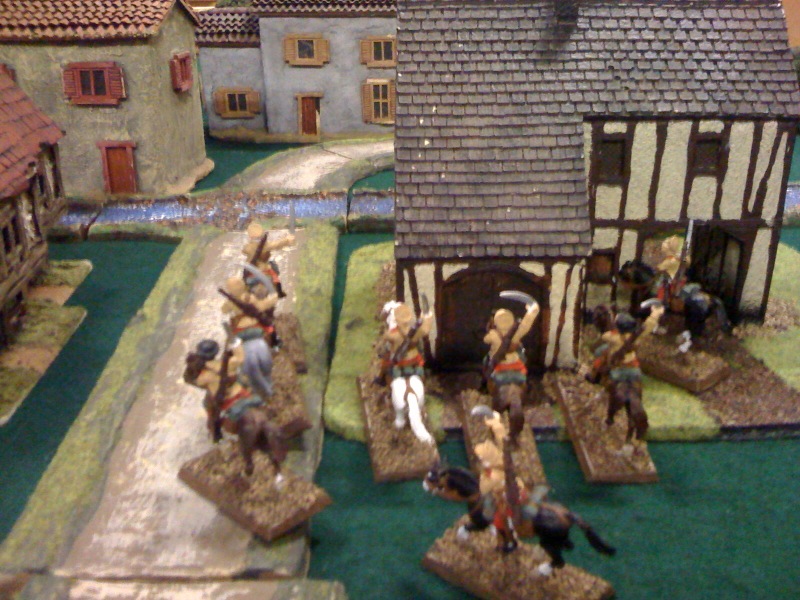
Lieutenat Kleftikon and his two NCOs were drinking tea and chatting up the farmer's daughter when the shapes emerged out the mist, charging down the meadow towards a gate entering onto the road (we moved it from where it is by Y on the map to the T junction). Kleftikon ordered one squad into the house to shoot at the Bolsheviks, while he ran with his other squad to the hedge so they could shoot at the Bolsheviks running down the meadow . However, there were too many of them, too close, so in the time honoured tradition of the Evzones he pulled out his sabre and with Corporal Stifados and his squad fixing bayonets, they charged the Bolsheviks (Heroic man card arrived in the nick of time), hoping to catch them at the gate, a narrow bottleneck, and drive them back.  Unfortunately it was not to be, and thee Bolsheviks rapidly overran Stifados's squad, wiping it - and Lieutenant Kleftikon - out. (Anybody within 9" can join in the scrap, even at a bottleneck)


Sneaky Bolsheviks sneaking round the farmhouses, ready to attack the unprepared Greeks (top of picture)


However, all the noise had alerted another squad camping in a nearby field, and they came running (arriving on table at point V) and occupied the farmhouse on the extreme left of the village where they started shooting at the bolshy Bolshies.. Lieutenant Kleftikon's heroic charge had also given the men in the orchard behind the farmhouse time to try and pull themselves together. This was ultimately to be decisive, but for now the Bolsheviks came pouring through the gate in numbers, one section grabbed a large log to batter the farmhouse door down, faltered after some desperate shooting from the Greeks in the houses, but with Rommelski urging them onwards for the Motherland (and threatening to shoot any dog who didn't go forward), they bashed down the door  before falling back in disorder as a hail of shots came out the house. However, they had done their job, and more Russian charged into the house and threw the Greeks out (the farmer and his family having long since fled).


Bolsheviks charge down the meadow to the field gate, hoping to overwhelm the unprepared Greeks before reinforcements can arrive. At the left top of the picture by the trees is Sergeant Stifados' squad, about to be led on a suicide charge by Lieutenant Kleftikon. Gee thanks....


However, the Greek troops in the fields behind the farmhouse had gathered their wits and promply charged the Russians in the farmhouse, and a fierce struggle ensued  which the Greeks eventually won (when in doubt, throw sixes) ejecting the Russians who retired back up the meadow and regrouped behind a stone wall, Rommelski furiouly urging them to try again. They were preparing for a second attack against the depleted Greeks, but at that moment the rest of the second Greek platoon arrived on the table and the Bolsheviks retired, leaving the somewhat shaken Greeks still in control of Bleidska.

Summary - a very exciting game, so exciting that we forgot to take any pictures of the ebb and flow fighting around the farmhouse - the "Mud & Blood" card system really worked well here, not only sowing uncertainty but also some uncannily timely cards - a Greek "Heroic Leader" card for the Lieutenant's charge, a "Friction" card causing delay among the men in the orchard when they saw teh Russian charge, a Russian "Up and at 'em" card just when the men battering down the door needed it most, and so on. It worked less well getting the Bolshevik force from far corner to the attack as the workflow is tedious going through cards waiting to activate each sub-unit, so we may institute "march moves" in future.

Monday, 10 January 2011

Odessa Files Part II - The Liman Race

Some photos from tonight's game - we played the "Mud & Blood" rules using the "Race to the Sea" scenario to teach ourselves the rules, except it was a "Liman Race" between Greeks and Bolsheviks around Odessa, 1919 during the Russian Civil War. (Liman are huge lagoons around Odessa - see map here, we played our action just East of Cerbka where the Greek and White Russian sectors intersected). The terrain map is shown below:


The objective is to seize the river bridge in the village on the right - the Greeks to stop the Bolsheviks crossing, the Reds to prevent the Greeks blowing it up.. The battle was fought between a Bolshevik force of about 1 platoon, complete with Putilov armoured car, and a Greek force of a similar size supported by a squad of White Russian Cossack cavalry. Here are some pictures- the Bolsheviks marching along from point B above:


And here are the Greeks marching along (below). These are the crack 5/42nd Evzones Regiment (don't know if they flew the flag in action in 1919, but all photos and pictures of Evzones have them heroically flying the flag, so by St Spiros mine do!).


The game was an honourable draw, the Whites/Greeks getting to the village first with the White Russian Cossack cavalry (below) and Greek cavalry but being pinned in the houses by the Putilov armoured car's twin machine guns (it broke down on the Russian side of the village just around that corner, thank heavens - the Greeks had nothing to hurt it with and it would have wreaked havoc) but the Bolshevik infantry could not approach the village as the Greeks were in the houses on their side and along the river bank covering the approach.


Rules were fine, but a bit slow as (i) we were learning them and (ii) they could be a bit better laid out, and the quick reference sheet has a lot of tables missing. We liked the unpredictability and things like the machine guns jamming, armoured car breaking down etc. Excuse the photos blurring, pictures were taken with mobile 'phone.

Tuesday, 14 December 2010

The Odessa File


For those of you interested in "Interbellum" (between the wars) gaming, this may be of interest. I have a Greek WW1 army and was curious about it's activities in the Russian Civil War. (This all kicked off because I wanted my Greeks to fight a friend's Russians, rather than always being on the same side as they were on the Salonika Front. My thanks to Mark Plant and Rudy Nelson for their help on The Miniatures Page - Mark has written a book, see here)

The Greeks were part of a force that occupied Odessa to support White Russia in the Ukraine. The force is an opportunity to field quite a polyglot outfit - White Russians, Poles, French, Greeks, Rumanians and various local bandit...I mean heroic rebel bands.

The army dispositions are shown in the map above, the army TO&E below - just look at the variety of units, all mixed together -  looks like some extremely good scenarios in this! In addition, some of the White Russian units' uniforms were truly over the top (look at these posts for the uniforms)

(Actually makes anything I can make up in my Byzantia 1920 Imagi-Nation fairly tame!)

A. Eastern Sector (See map above)
=========================

Command:
– General Nérel, commander of the [French] 30th ID;
– HQ at Odessa;
– Command post at Gevanova.
Troops:
– Infantry
– [French] 40th IR;
– two regiments of the Greek 13th ID;
– one regiment of the Greek 2nd ID;
– detachment of Russian Volunteer Army in cover.
– Artillery:
– one group from the divisional artillery of the [French] 30th ID;
– artillery of the Greek 13th ID;
– field and heavy artillery of the Russian Volunteer Army
– Cavalry
– two squadrons of the 4th Chasseurs d’Afrique and one battalion of MGs
– one squadron of Russian Volunteer Army

I. The advanced line ran along the Cerbka river, the bridge at Popovca on the Tilgulski [Liman}and the
defile of Koblievo-Troïtkoïe. Covered to the east by a detachment of the Russian Volunteer Army
operating between the Berezanski Liman and the Tiligulski Liman (1 battalion, 2 squadrons and 2 guns), it
was divided into three parts:

a. Under the orders of Lieutenant-Colonel de Clavières:
– advanced post of Cerbka
– advanced post of Pocrovscoe;
– bridge of Popovca.
– advanced post of Cerbka under the orders of Colonel Manetas and consisting of:
– one Greek IR;
– one Greek artillery group;
– two [French?] 75mm batteries;
– one Greek engineer company;
– one squadron of the 4th Chasseurs d’Afrique;
– one Greek infantry battalion at Bol Buyalic in support,
limited to the east by the Tchernogorka to Krasnogorka (included) road and to the west by the
Gradenfeld to Andriewka road, and liaising to the east with the Russian Volunteer Army
detachment and to the west with the Polish cavalry at Liebenthal.
– advanced post of Pocrovscoe under the orders of the commander of the Russian Volunteer Army
detachment and disposing of:
– four infantry companies;
– 36 machine-guns;
– two squadrons on foot;
– 10 guns,
limited to the west by the Tchernogorka to Krasnogorka road and the east by the village of Kapri.
Liaising to the west with the advanced post of Cerbka on the river of the same name and to the
east to the village of Kapri with the advanced post of Popovka.
– advanced post of Popovka held by two companies and 16 MGs of the Russian Volunteer Army in liaison
to the west with the company of the Russian Volunteer Army in Kapri and to the east with the garrison of
Koblievo at Savnia.

b. Fortified line of Koblievo-Troitkoie, under the orders of the commander of the Greek battalion
occupying the line and possessing a Greek battalion and 4 guns of the Russian Volunteer Army, limited to
the west by Tiligulski Liman and to the east by the sea. Liaison to the west to the village of Savnia with the
Russian Volunteer Army detachment at Popovka.

c. Cover to the east, under the direct orders of the general commanding the 1st Divisional Group
comprising a squadron of the Russian Volunteer Army (bulk at Krasnaia) patrolling in the direction of
Lubianka and Cozlo with a line of retirement on Koblievo-Troitkoie. The Russian Volunteer Army
occupied, as well, Otchakov, Fort National and Fort Kimburn.
The admiral to give all necessary orders to support, with the fleet, the occupation of Fort National and,
eventually, the evacuation of Otchakov.

II. An intermediate line, passing through Bol Buyalik and Kremidovska, to be held by:
– one Greek battalion;
– one half-company of Greek engineers;
– one French cavalry squadron;
– one platoon of French MGs;
– one French 75mm battery,
and placed in reserve at the disposition of the colonel commanding the 4th Chasseurs d’Afrique.

III. The principal line, under the orders of the colonel commanding the 30th ID, consisting of:
– two Greek battalions (of which one detached to the Troitkoie line);
– one French regiment;
– one Greek 75mm battery,
was divided into two sub-sectors each occupied by a Greek battalion and organised defensively:
– one sub-sector from the sea to Kouialnitchki Liman;
– one sub-sector from Kouialnitchki Liman to Gadjibiesky Liman.
In reserve, a French regiment at Marewska at the disposition of the general commanding the eastern sector.


B. Western Sector
=============

Placed under the orders of General Borius, commander of the [French] 156th ID, limited between
Gadgibiesky Liman [exclusive] and the Dniestr (exclusive) and consisting of:
– a sub-sector of defence, properly speaking;
– Odessa itself;
– a detachment in cover at the water plant under the direct orders of the general commanding the 1st
Divisional Group.

I. Sub-sector of defence, under the orders of General Borius, limited to the east by Gadgibiesky Liman and
the Dniestr to the west, in liaison to the east around Andriewka with the Polish Cavalry and to the west, on
the Dniestr, with the Romanian units occupying Tiraspol and consisting of:
– Infantry:
– one regiment of the [French] 30th ID;
– one regiment of the [French] 156th ID;
– one regiment of the Greek 2nd ID;
– one Romanian infantry regiment, under certain conditions.
– Cavalry:
– one regiment of Polish cavalry.
– Artillery:
– one group from the divisional artillery of the [French] 30th ID;
– one group from the Greek 13th ID;
– one Romanian group.

II. Advanced line: Under the orders of the lieutenant-colonel commanding the [French] 58th IR, running
along the railway to Razdelnaia and consisting of:
– the advanced post of Razdelnaia-Tiraspol;
– Tiraspol;
– the detachment at Bielajewska.

a. The advanced post of Razdelnaia-Tiraspol, under the orders of the commander of the 1st battalion of the
58th IR and comprising:
– one Romanian battalion;
– one battalion of the 58th IR (less one section);
– one Romanian battery,
in liaison to the east with the Polish cavalry around Poniatowka and to the west with the garrison of
Tiraspol around Strasburg.

b. Tiraspol, under the orders of the lieutenant-colonel commanding the Romanian regiment and consisting
of:
– two Romanian battalions;
– one Romanian battery;
– one section of the [French] 58th IR,
in liaison to the east with the garrison of Razdelnaia around Strasburg, to the west with the Romanian
troops of Bessarabia at the Bender bridge. The liaison with the advanced post of Cerbka (eastern sector)
and with Razdelnaia (western sector) was confided to the Polish cavalry of which the bulk was at
Chimiotowka, under the direct orders of the lieutenant-colonel commanding the 58th IR.

c. Detachment at Bielajewska [the water plants] under the direct orders of the general commanding the 1st
Divisional Group and consisting of:
– three infantry companies;
– one squadron;
– one battery.
of the Polish 4th ID.

III. The intermediate line, under the orders of the lieutenant-colonel commanding the [French] 58th IR,
holding Novodlagodatnaya with the staff of the regiment and one battalion of the 58th IR.

IV. The principal line, established at 6 to 8 kilometres from Odessa, running via Ustowa, Dalnik and
Tatarka, under the orders of Colonel Gargalidis, commander of the Greek 2nd ID and held by one infantry
regiment of that division.

Odessa
===== 

This was placed under the orders of General Borius, the governor, charged
with the interior defence of the town. The defence was to be based on the organisation of a principal line
established around the rail line and a redoubt in support of the port.
The support of the fleet was to be realised by agreement between the governor and the admiral
commanding the naval forces in Odessa.

General Borius had for the defence of the town:
– the [French] 156th ID (less a regiment);
– one company of the legion;
– one regiment of tirailleurs algériens;
– the 4th regiment of Chasseurs d’Afrique, less two squadrons;
– the remainder of the Polish 4th ID;
– the remainder of the Russian Volunteer Army;
– the Russian police;
– the disembarked companies [naval landing parties]
– the staging battalions (Indo-Chinese for the port guard and Algerian for the redoubt).

A general reserve, at the disposition of the general commanding the 1st Divisional Group, consisted of:
– one infantry regiment of the Greek 2nd ID and the advised reinforcements;
– tanks of the AS/303 (one section at Peressip, one at the station, one in the proximity of the HQ)
– the 534th Hellenic Aviation Sq. (As best as I can work out equi[pped with DeHavilland DH.4 or 9)

The Battles were:

Defense of Kherson Russia = January 17-February 25 1919. A series of bitter engagements fought against Red Russian forces. Units of the Greek 7th and 34th Divisions conducted a combination of attacks, reinforcing and defensive operations.

Battle of Vasilinovo and Berezovka Russia = February 8- March 5 1919. A series of bitter engagements fought against Red Russian forces. Units of the Greek 1st and 34th Divisions conducted a combination of attacks, reinforcing and defensive operations.

Relief of Kherson = February 23, 1919. The Greek 1st regiment broke through the Red lines surrounding Kherson long enough to evacuate the besieged Allied garrison.

Battle around Odessa = March 6-21 1919. The Greek 3rd, 34th and 5/42nd Regiments fight a series of engagements around the city of Odessa.

Operations in Sevastapol = March 1919. The Greek 2nd Regiment is involved in several battles around the city.

Defense of Odessa = March-April 1919. The Greek forces in the city delay the Red Forces by using a fighting withdrawal tactic